Managing appointment changes has become one of the biggest operational challenges for modern healthcare providers. Every day, hospitals, clinics, dental practices, and specialty care centers receive hundreds of calls from patients requesting to reschedule, cancel, or modify appointments. These routine administrative tasks consume valuable front-desk time, increase patient wait times, and often contribute to missed appointments when patients cannot reach the clinic quickly.
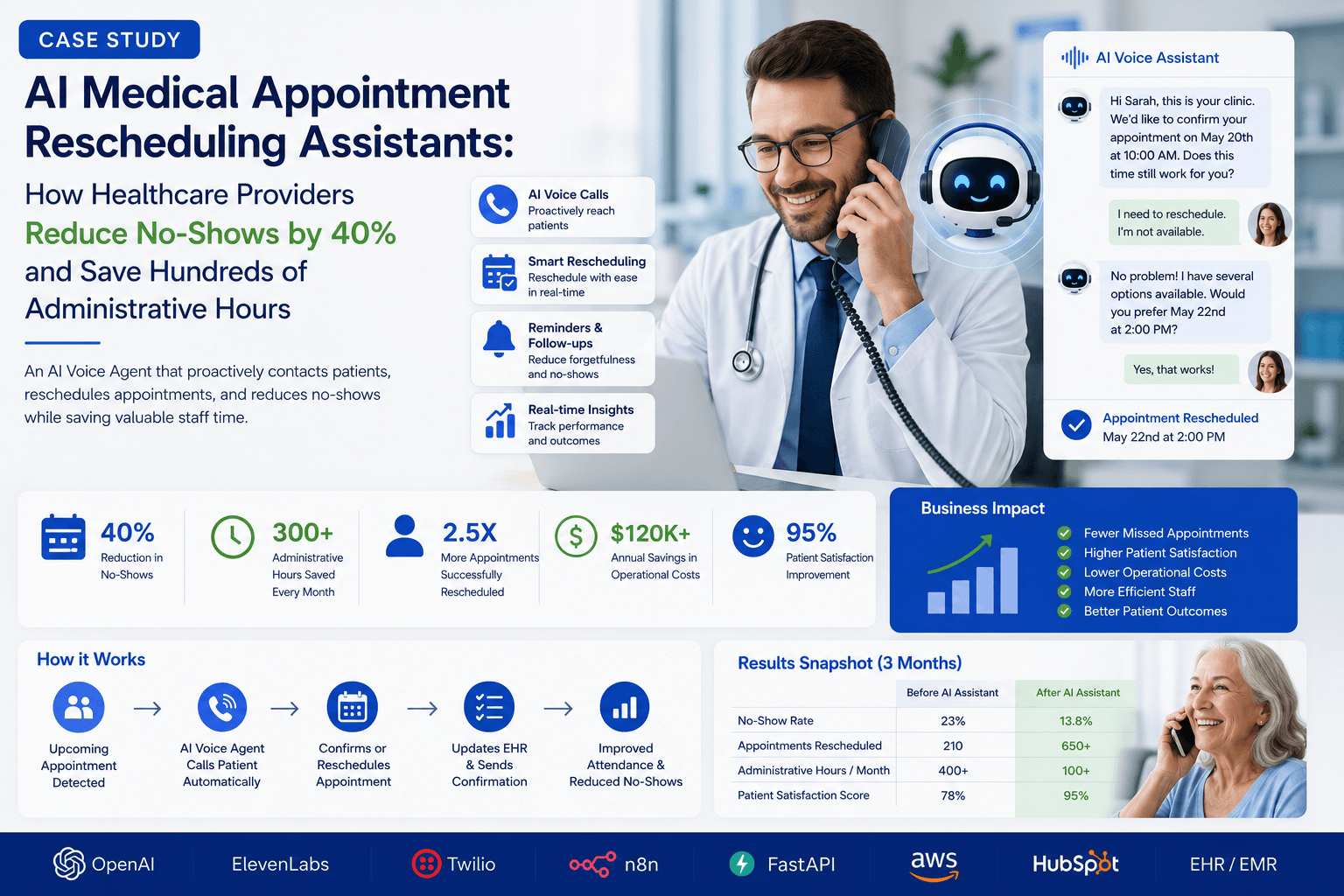
An AI Medical Appointment Rescheduling Assistant transforms this experience by automating the entire rescheduling process through natural, human-like conversations. Available 24/7, these AI-powered voice agents can verify patient identity, access real-time provider availability, recommend the best appointment slots, update calendars instantly, and send automated confirmations via SMS or email—all without requiring human intervention.
Unlike traditional Interactive Voice Response (IVR) systems that rely on complex menus and keypad inputs, modern AI scheduling assistants leverage Natural Language Processing (NLP), Large Language Models (LLMs), and conversational AI to understand patient intent naturally. Whether a patient says, "I need to move my appointment to next week," or "Can I see the doctor on Friday morning instead?", the AI interprets the request, checks scheduling constraints, and completes the transaction in seconds.
Why Traditional Appointment Rescheduling Is No Longer Sustainable
Healthcare organizations continue to face increasing patient volumes while simultaneously experiencing staffing shortages and rising operational costs. Front-desk personnel often spend more than half of their working hours handling repetitive scheduling calls rather than supporting patients inside the clinic.
When patients are placed on hold or cannot reach the practice during business hours, many postpone calling back or simply miss their appointments altogether. These no-shows result in unused physician time, delayed patient care, reduced revenue, and inefficient resource utilization.
AI Appointment Scheduling eliminates these bottlenecks by providing immediate assistance around the clock. Patients no longer need to wait for office hours or speak with multiple staff members just to modify an appointment, creating a significantly better healthcare experience while reducing administrative burden.
How AI Medical Appointment Rescheduling Assistants Work
An AI scheduling assistant follows a secure and intelligent workflow designed specifically for healthcare environments. Once a patient initiates a phone call or chat conversation, the assistant verifies their identity using approved authentication methods such as date of birth, registered phone number, patient ID, or appointment details.
After verification, the AI connects with the clinic's Electronic Health Record (EHR), Electronic Medical Record (EMR), or Practice Management System (PMS) to retrieve real-time appointment availability. Instead of offering generic slots, the assistant considers physician schedules, appointment duration, specialty-specific rules, clinic working hours, and scheduling preferences before presenting the most suitable options.
Once the patient selects a preferred time, the assistant automatically updates the calendar, synchronizes all integrated systems, triggers confirmation emails and SMS reminders, and records the interaction for auditing and compliance purposes.
Real-World Business Impact
Consider a multi-specialty medical practice with over 40 physicians receiving approximately 700 appointment-related calls every day. During peak hours, patients regularly waited more than ten minutes to speak with a receptionist, leading to abandoned calls and increased appointment no-shows.
After implementing an AI Medical Appointment Rescheduling Assistant, more than 75% of routine scheduling requests were handled automatically. Administrative teams redirected their focus toward insurance verification, patient onboarding, and in-clinic support, while patients experienced immediate service regardless of the time of day.
Within six months, the organization observed shorter call queues, improved appointment utilization, higher patient satisfaction scores, and substantial reductions in scheduling-related administrative workload.
Core Technologies Powering AI Scheduling Assistants
Modern AI appointment scheduling solutions combine multiple advanced technologies to deliver seamless patient interactions and reliable automation.
- Large Language Models (LLMs) for understanding natural conversations.
- Natural Language Processing (NLP) for interpreting patient intent accurately.
- Automatic Speech Recognition (ASR) for converting spoken language into text.
- Text-to-Speech (TTS) for delivering natural and human-like voice responses.
- Workflow Automation Platforms such as n8n and Zapier for orchestrating scheduling workflows.
- Healthcare APIs including FHIR and HL7 for secure interoperability.
- Calendar Integrations with Google Calendar, Microsoft Outlook, and scheduling platforms.
- Voice Infrastructure powered by Twilio, Retell AI, ElevenLabs, or Deepgram for enterprise-grade conversational experiences.
Business Benefits for Healthcare Providers
Deploying an AI Medical Appointment Rescheduling Assistant delivers measurable operational improvements across healthcare organizations. By automating repetitive scheduling activities, clinics reduce administrative costs, improve physician utilization, enhance patient satisfaction, and provide consistent service around the clock.
- Provide 24/7 appointment management without increasing staffing costs.
- Reduce patient no-shows through frictionless rescheduling and automated reminders.
- Decrease administrative workload by automating repetitive scheduling tasks.
- Improve patient experience with instant, human-like conversations.
- Minimize scheduling errors through real-time calendar synchronization.
- Increase physician calendar utilization and operational efficiency.
- Scale appointment management across multiple clinics and locations.
- Generate valuable analytics on patient behavior, cancellations, and scheduling trends.
Why AI Scheduling Is Becoming the Standard in Healthcare
Healthcare is rapidly embracing automation to improve both operational efficiency and patient satisfaction. AI Medical Appointment Rescheduling Assistants represent one of the fastest-return investments because they solve a high-frequency administrative problem that affects every healthcare provider. As conversational AI continues to evolve, these assistants will become increasingly proactive, capable of predicting cancellations, optimizing physician schedules, and personalizing patient communication based on historical behavior.
For hospitals, clinics, dental practices, and specialty healthcare providers, implementing AI-powered appointment rescheduling is no longer simply an efficiency upgrade—it is becoming a competitive advantage that improves accessibility, reduces costs, and delivers a modern patient experience expected in today's digital healthcare landscape.
AI vs Traditional Appointment Rescheduling
| Feature | Traditional Scheduling | AI Rescheduling Assistant |
|---|---|---|
| Availability | Office Hours Only | 24/7 Availability |
| Call Waiting | Often 5–20 Minutes | Instant Response |
| Appointment Updates | Manual | Automated |
| Calendar Sync | Manual | Real-Time |
| Patient Verification | Staff Dependent | Automated |
| Multiple Locations | Difficult | Easily Managed |
| Administrative Cost | High | Lower |