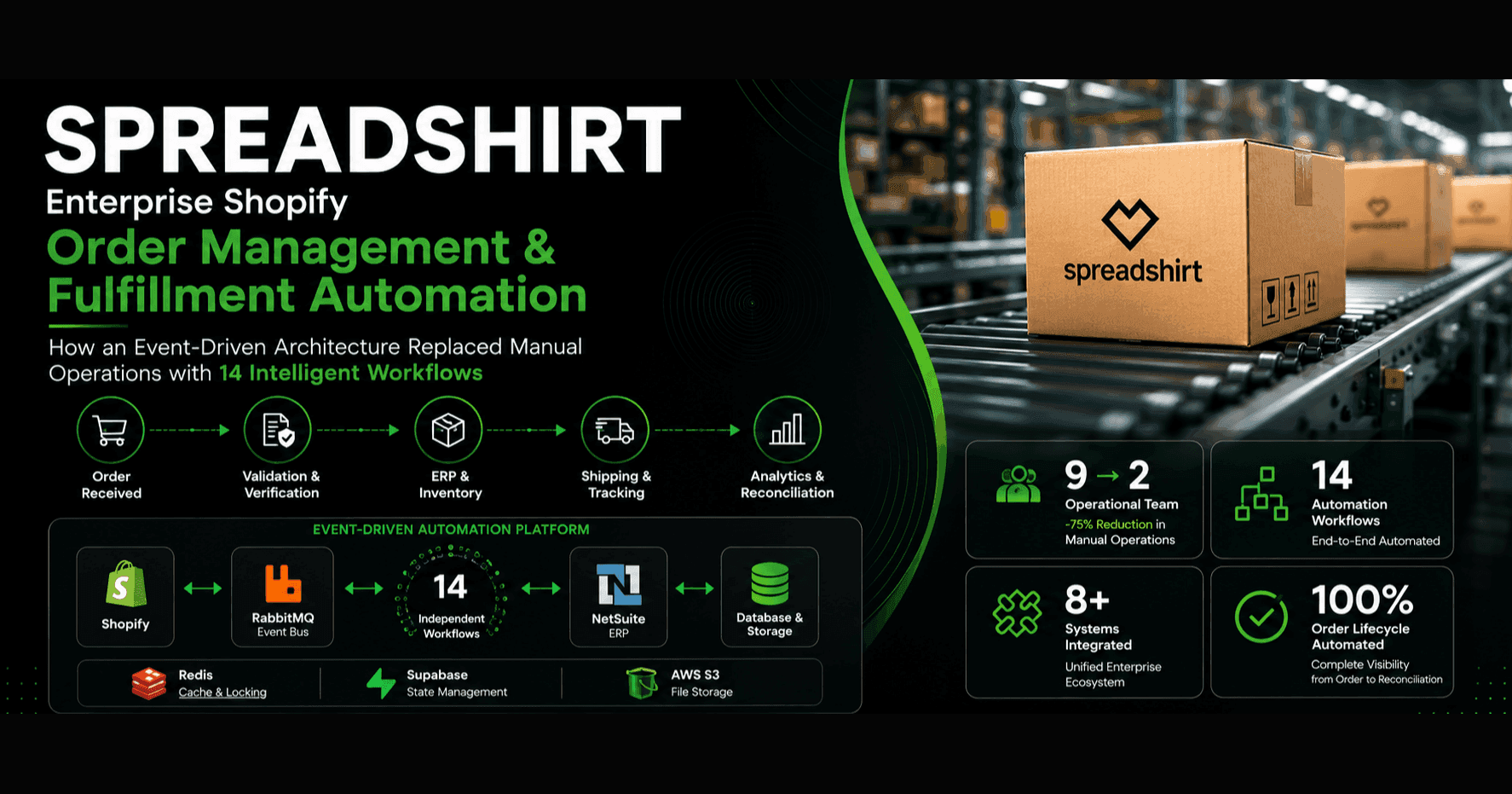
We developed a 14-workflow, event-driven Shopify Order Management & Fulfillment Platform for Spreadshirt using n8n, RabbitMQ, Supabase, Redis, NetSuite, and Shopify. The solution automated the complete order lifecycle, reduced operational dependency from 9 employees to 2, and created a scalable, reliable automation platform capable of supporting future business growth.
Spreadshirt's Shopify fulfillment relied on manual coordination across multiple teams and disconnected systems. Every order required repetitive tasks such as validation, ERP updates, inventory management, invoicing, shipping, and customer communication. As daily volumes reached 5,000 units, processing delays, operational costs, and the risk of human error increased, making the workflow difficult to scale without continuously expanding the operations team.
We built a 14-workflow, event-driven Order Management & Fulfillment Platform using n8n, RabbitMQ, Supabase, Redis, Shopify, NetSuite, and eShipper. The platform automates the complete order lifecycle, from order intake and validation to inventory allocation, invoicing, shipping, notifications, reconciliation, and analytics, while providing centralized workflow orchestration, fault tolerance, and complete operational visibility.
The automation platform transformed Spreadshirt's fulfillment operations by reducing operational dependency from 9 employees to 2 while automating the complete order lifecycle. The solution now processes 5,000 units daily through a scalable, enterprise-grade architecture, delivering faster processing, improved consistency, real-time visibility, and a foundation capable of supporting continued business growth without increasing operational overhead.
01. Executive Summary
Executive Summary
Spreadshirt's order fulfillment process relied on multiple employees performing repetitive operational tasks across several disconnected systems. Every incoming Shopify order required manual validation, customer synchronization, ERP order creation, inventory updates, invoice generation, shipment booking, tracking updates, reconciliation, and customer communication. As order volumes increased, operational complexity grew proportionally, making scaling expensive and introducing unnecessary processing delays.
Our objective was not simply to automate individual tasks, but to redesign the entire operational workflow around an event-driven architecture capable of handling every stage of the order lifecycle independently and reliably.
We designed and implemented a distributed Order Management & Fulfillment Automation Platform consisting of fourteen interconnected workflows orchestrated through RabbitMQ, with n8n acting as the workflow engine and Supabase serving as the centralized operational state database. Redis was introduced to ensure distributed locking and prevent duplicate processing, while NetSuite, Shopify, and eShipper were integrated into a unified automation ecosystem.
The platform now manages the complete journey of an order, beginning the moment a Shopify order is created and continuing through validation, customer synchronization, payment verification, fraud detection, ERP order creation, inventory allocation, invoice generation, procurement handling, shipment booking, shipment tracking, customer notifications, reconciliation, and operational analytics.
Unlike traditional automation implementations that rely on large monolithic workflows, the solution was engineered as fourteen independent services. Each workflow performs a single business responsibility, allowing the platform to scale horizontally, recover gracefully from failures, intelligently retry failed operations, and maintain complete traceability throughout every order's lifecycle.
The implementation significantly reduced manual operational effort by eliminating repetitive administrative work across multiple departments. Processes that previously required approximately nine operational staff members can now be supervised by only two operators, enabling the client to focus human resources on exception handling and customer experience rather than repetitive execution.
Beyond immediate operational improvements, the architecture established a long-term digital foundation capable of supporting future business growth without requiring proportional increases in operational staffing.
02. Operational Challenges
The Challenge: Scaling Operations Without Scaling Headcount
Spreadshirt's order fulfillment process had evolved around manual operational workflows that required constant coordination between multiple employees and disconnected business systems. Every incoming Shopify order triggered a sequence of repetitive tasks across customer management, payment verification, ERP creation, inventory allocation, invoicing, shipping, tracking, and customer communication. While each task appeared manageable in isolation, the cumulative operational effort increased significantly as daily order volumes grew.
The existing workflow relied on approximately eight to nine employees performing repetitive operational activities throughout the day. Orders were manually validated, customer information was synchronized across platforms, ERP entries were created by hand, inventory adjustments were processed manually, invoices were generated separately, logistics partners were contacted individually, shipment updates were tracked across multiple systems, and customers received manual status communications.
This fragmented process introduced operational bottlenecks that directly affected processing speed, operational costs, and scalability. Teams frequently switched between Shopify, NetSuite, inventory systems, shipping platforms, spreadsheets, and communication tools simply to complete the lifecycle of a single order. Because each department worked independently, delays in one stage often created downstream bottlenecks that impacted the entire fulfillment pipeline.
As order volumes increased during promotional campaigns and seasonal demand, the business faced a fundamental scaling challenge. Supporting higher transaction volumes would require hiring additional operational staff rather than improving operational efficiency. The client needed a solution capable of automating repetitive processes while maintaining business accuracy, system reliability, and complete operational visibility.
Beyond automation, the objective was to redesign the operational architecture itself. Instead of creating isolated automations for individual tasks, the goal was to build a unified, event-driven platform capable of orchestrating the complete order lifecycle from the moment an order was received until successful delivery and post-fulfillment reconciliation.
The solution also needed to integrate seamlessly with existing business systems, preserve data consistency across platforms, support intelligent error recovery, prevent duplicate processing, and provide a scalable foundation capable of supporting future business growth without proportional increases in operational overhead.
03. Before vs. After Workflow
The original order processing workflow was highly dependent on manual coordination between multiple employees and business applications. Each Shopify order initiated a chain of disconnected operational activities that required human intervention at nearly every stage. Validation, ERP creation, inventory updates, invoicing, shipping coordination, customer communication, and reconciliation were all handled independently, resulting in duplicated effort, inconsistent processing times, and increased opportunities for operational errors. The absence of centralized orchestration meant that employees frequently switched between systems to monitor order progress, manually resolve dependencies, and ensure downstream teams received the information required to continue processing. Operational visibility was limited, making it difficult to identify where an order was delayed or which task required attention.
The manual operational model was replaced with a fully automated, event-driven order orchestration platform consisting of fourteen interconnected workflows. Every workflow performs a single business responsibility while communicating with the rest of the platform through standardized events published over RabbitMQ. Once an order is received from Shopify, the platform automatically validates customer information, verifies payments, performs fraud checks, creates ERP records, manages inventory allocation, generates invoices, books shipments, tracks deliveries, sends customer notifications, performs reconciliation, and records operational analytics with minimal human intervention. Instead of employees coordinating between systems, the automation platform orchestrates every stage of the order lifecycle independently while maintaining complete traceability, intelligent retry mechanisms, centralized state management, and fault-tolerant processing. Human involvement is now limited primarily to handling business exceptions rather than executing repetitive operational tasks.
04. The Solution & Architecture
Engineering a Scalable Event-Driven Order Management Platform
Spreadshirt's objective extended far beyond automating repetitive tasks. The goal was to completely redesign the order fulfillment lifecycle into a scalable, resilient, and intelligent operational platform capable of processing orders with minimal human intervention.
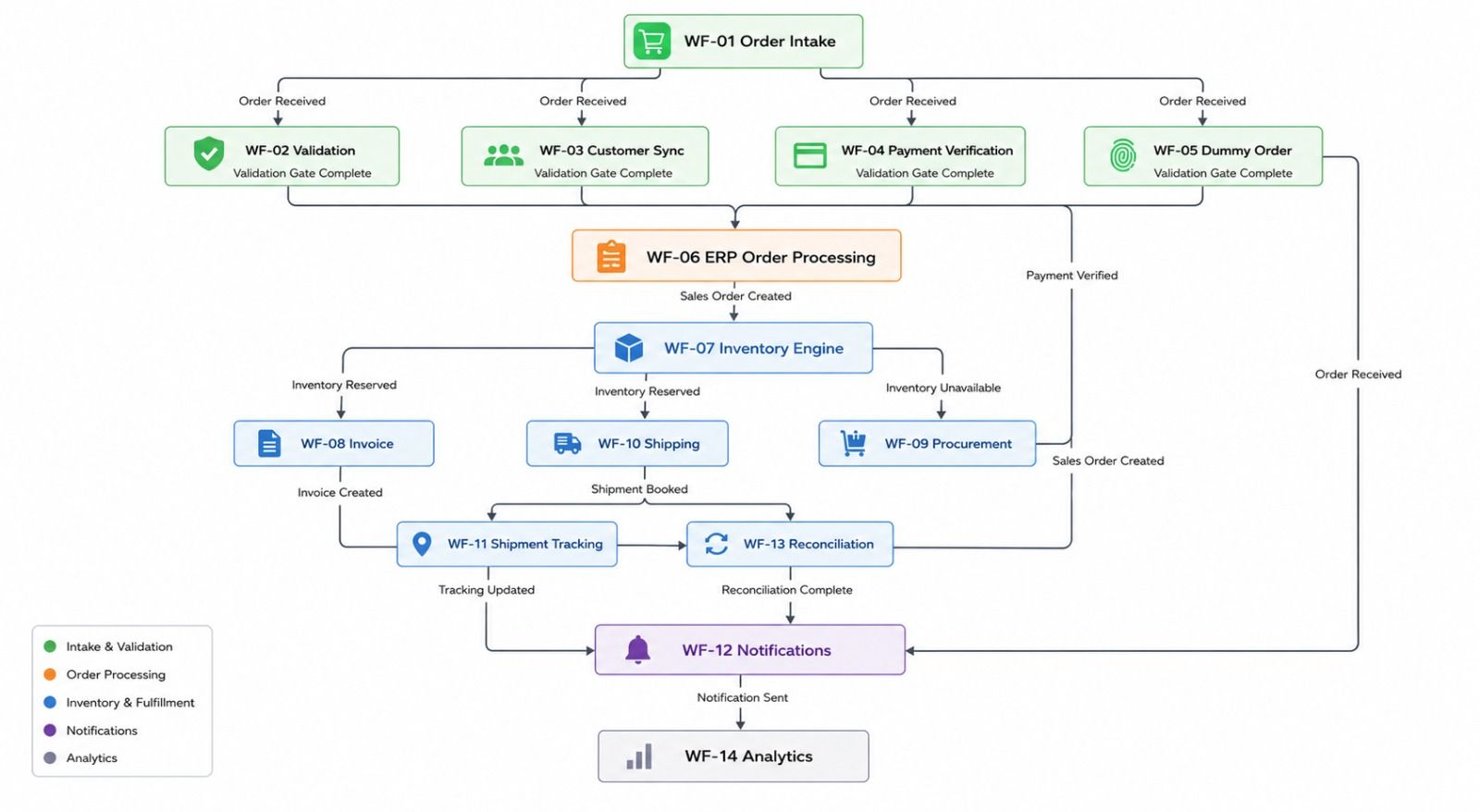
Instead of building a single monolithic workflow, we engineered an event-driven automation architecture consisting of 14 independent workflows, each responsible for a single business capability. This modular approach improves scalability, fault isolation, maintainability, and long-term extensibility while allowing every workflow to operate independently.
Every new Shopify order enters the platform through a centralized intake workflow where a unique Correlation ID is generated, enabling complete traceability throughout the order lifecycle. The order is then distributed into multiple validation workflows that execute in parallel, including business validation, customer synchronization, payment verification, and fraud detection. Once every validation completes successfully, the platform automatically progresses through ERP creation, inventory allocation, invoice generation, procurement handling, shipment booking, shipment tracking, customer notifications, reconciliation, and operational analytics.
Core Engineering Principles
- Modular workflow architecture
- Event-driven communication
- Parallel workflow execution
- Centralized workflow state management
- Intelligent retry mechanisms
- Idempotent processing
- Distributed concurrency control
- End-to-end traceability
- Fault isolation and recovery
The platform uses RabbitMQ as the event backbone to decouple workflows and eliminate dependencies between business processes. Supabase acts as the centralized operational state database, while Redis ensures distributed locking and prevents duplicate processing during high-volume execution.
Every workflow follows standardized engineering practices including structured event publishing, centralized logging, workflow state transitions, retry policies, and dead-letter queue handling. This allows the platform to gracefully recover from temporary failures without interrupting downstream operations.
Rather than replacing employees with automation, the platform transforms manual operations into an intelligent orchestration system where people focus only on business exceptions while automation manages repetitive execution.
The result is a production-ready automation platform capable of supporting future business growth without requiring proportional increases in operational staff.
05. Implementation Timeline
Discovery & Analysis
Week 1Solution Architecture
Week 2Core Workflow Development
Weeks 3–4Advanced Integrations
Weeks 5–6Testing & Validation
Week 7Optimization & Deployment
Week 806. ROI & Financial Analysis
Return on investment calculated over 12 months post-deployment.
07. Client Feedback
""The automation platform fundamentally changed how our operations team manages order fulfillment. Tasks that previously required continuous manual coordination now execute seamlessly through an integrated workflow system. The architecture not only reduced operational effort but also established a scalable foundation capable of supporting future business growth.""
08. Lessons & Takeaways
Modular Architectures Scale Better
Breaking complex business operations into independent workflows significantly improves scalability, maintainability, testing, and long-term extensibility compared to large monolithic automation pipelines.
Events Reduce System Dependencies
Using asynchronous event-driven communication allows individual workflows to evolve independently while maintaining reliable coordination across the entire order lifecycle.
Reliability Must Be Designed
Production automation requires much more than workflow logic. Retry mechanisms, distributed locking, idempotent processing, centralized logging, and fault isolation are essential for long-term operational stability.
Automation Is Process Redesign
The greatest business impact comes from redesigning operational workflows rather than simply automating isolated manual tasks.