Multiple AI agents automated the complete order-to-cash process, improving operational efficiency, reducing manual work, and enabling the business to scale without increasing headcount.
The company struggled with manual, disconnected order-to-cash processes that caused delays, errors, and inefficient operations, making it difficult to scale as order volumes increased.
The company implemented a multi-agent AI system that automated the entire order-to-cash process by connecting ERP, CRM, inventory, invoicing, shipping, and customer communication into a single intelligent workflow.
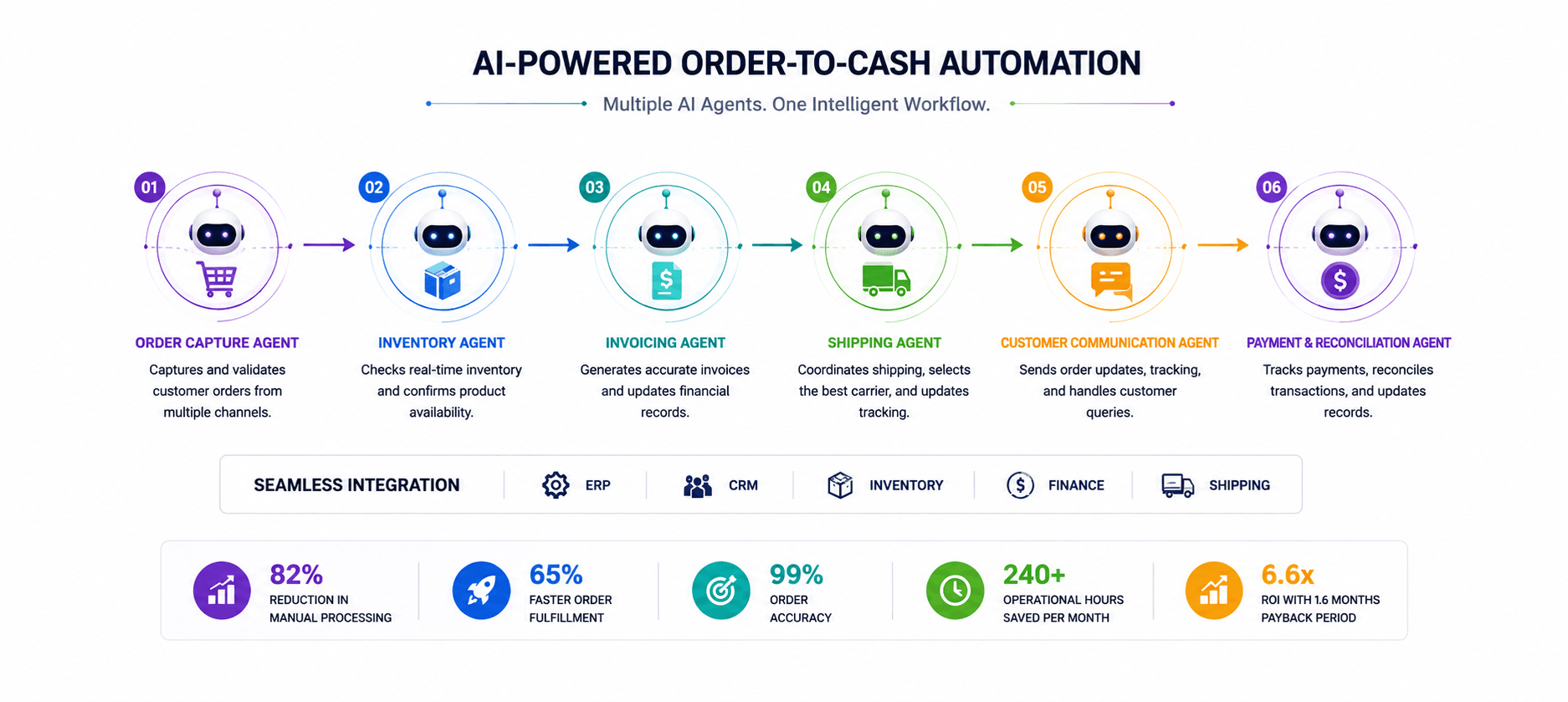
The solution reduced manual processing by 82%, accelerated order fulfillment by 65%, achieved 99% order accuracy, and saved over 240 operational hours per month.
01. Executive Summary
As order volumes increased, a wholesale distribution company struggled with disconnected processes across order management, inventory, invoicing, shipping, and customer communication. Manual workflows caused delays, errors, and made it difficult to scale operations efficiently.
To address these challenges, the company deployed a multi-agent AI system that automated the entire order-to-cash process. Within ten weeks, the solution reduced manual processing by 82%, accelerated order fulfillment by 65%, achieved 99% order accuracy, and saved over 240 operational hours per month, enabling scalable growth without increasing operational headcount.
02. Operational Challenges
As the business expanded, its order-to-cash process relied heavily on manual coordination between sales, inventory, finance, logistics, and customer support teams. Employees had to transfer information across multiple systems, resulting in delays, duplicate work, and frequent processing errors.
The lack of workflow automation made it difficult to process orders quickly, maintain inventory accuracy, generate invoices on time, and keep customers informed. The company needed an intelligent solution that could connect these processes, eliminate repetitive tasks, and scale operations without increasing headcount.
03. Before vs. After Workflow
Before implementing the multi-agent AI system, every stage of the order-to-cash process required manual effort. Teams validated orders, checked inventory, created invoices, coordinated shipments, updated customer records, and shared status updates across multiple disconnected systems, leading to delays and operational inefficiencies.
After deploying the multi-agent AI system, specialized AI agents automated the entire order-to-cash workflow. Orders were validated, inventory updated, invoices generated, shipments coordinated, and customers notified automatically, allowing employees to focus on exceptions and strategic tasks while improving speed, accuracy, and operational efficiency.
04. The Solution & Architecture
The company implemented a multi-agent AI system to automate the entire order-to-cash process. Integrated with its ERP, CRM, inventory, accounting, and shipping systems, specialized AI agents collaborated to process orders, manage inventory, generate invoices, coordinate shipments, and update customers in real time.
The multi-agent system was configured to:
- Validate and process incoming orders
- Check inventory availability
- Generate invoices and payment requests
- Coordinate shipping and fulfillment
- Update ERP and CRM records automatically
- Send proactive customer notifications
- Escalate exceptions to the appropriate teams
By automating end-to-end workflows, the company reduced manual effort, improved processing speed and accuracy, and enabled seamless scaling without increasing operational headcount.
05. Implementation Timeline
Process Discovery & Workflow Mapping
Week 1–2AI Agent Development & Integrations
Week 3–5Testing & Optimization
Week 6–8Deployment & Performance Monitoring
Week 9–1006. ROI & Financial Analysis
Return on investment calculated over 12 months post-deployment.
07. Client Feedback
""Before implementing the multi-agent AI system, our teams spent countless hours moving information between systems and manually coordinating every stage of the order-to-cash process. Today, our AI agents work together seamlessly, eliminating bottlenecks, improving accuracy, and allowing our employees to focus on higher-value work. The impact on operational efficiency and scalability has exceeded our expectations.""
08. Lessons & Takeaways
Process Mapping Comes First
Understanding the complete order-to-cash workflow before automation helped identify bottlenecks, reduce unnecessary steps, and ensure every AI agent had a clearly defined responsibility.
AI Agents Perform Better Together
Assigning specialized roles to multiple AI agents improved coordination across sales, inventory, finance, logistics, and customer communication, creating a seamless end-to-end workflow.
System Integration Is Critical
Integrating the AI agents with ERP, CRM, accounting, and shipping platforms enabled real-time data sharing and eliminated manual data entry across departments.
Human Oversight Still Adds Value
While AI automated routine operations, human teams remained essential for approvals, exception handling, and strategic decision-making.
Continuous Optimization Improves Results
Regularly monitoring workflows and refining AI agent logic increased automation accuracy, reduced processing time, and supported long-term operational efficiency.
This case study shows how multiple AI agents automated the entire order-to-cash process, reducing manual work, improving operational accuracy, and enabling the business to scale efficiently without increasing headcount.