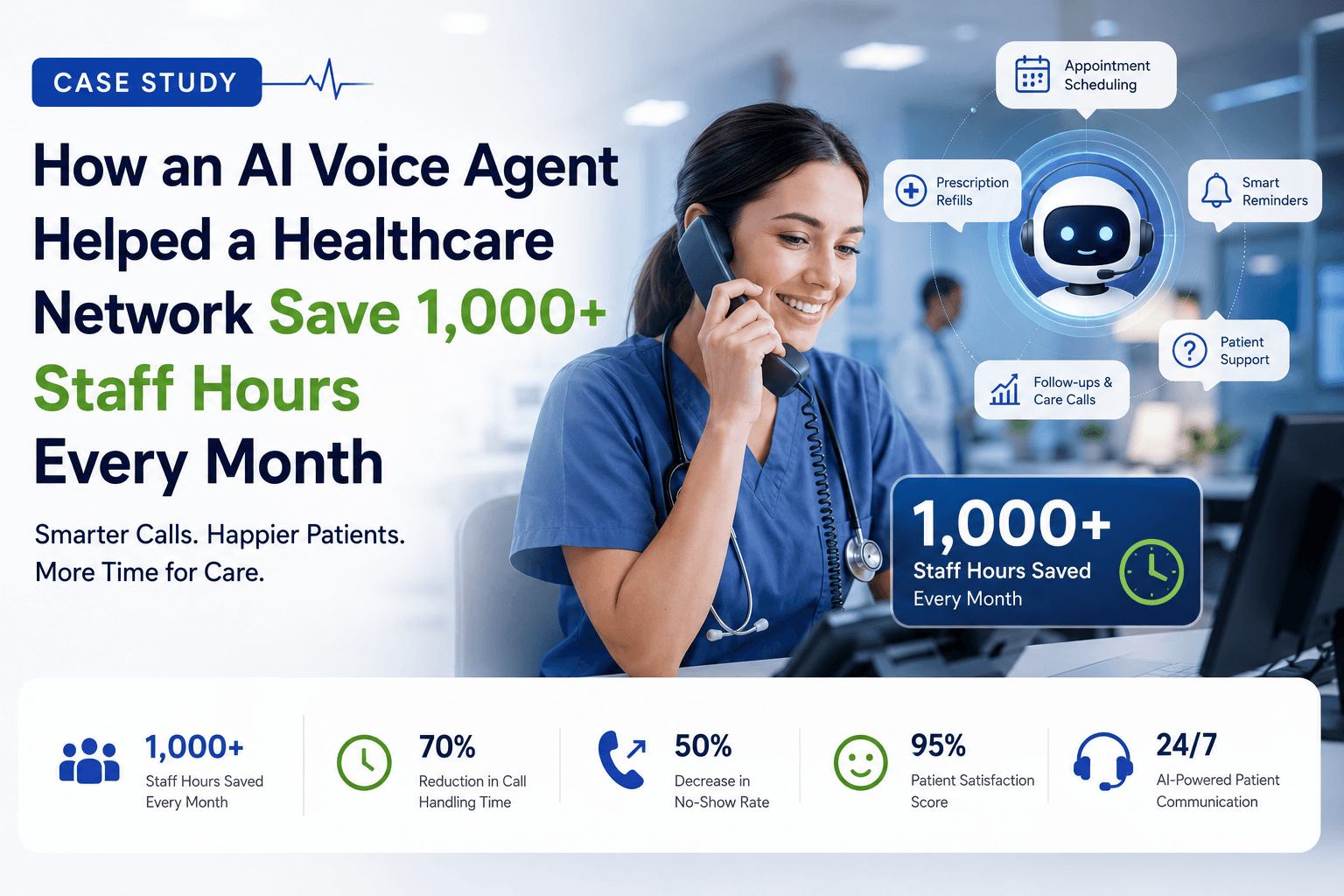
How an AI Voice Agent Helped a Healthcare Network Save 1,000+ Staff Hours Every Month
A multi-location healthcare provider transformed patient communication with an AI Voice Agent that automated appointment scheduling, reminders, FAQs, and follow-ups. The result was over 1,000 staff hours saved every month, fewer missed appointments, and a smoother experience for both patients and employees.
Healthcare organizations handle thousands of repetitive patient calls every day. This case study explores how a custom AI Voice Agent automated scheduling, reminders, FAQs, and patient support to improve operational efficiency, reduce administrative workload, and create a better healthcare experience.
An AI Voice Agent enabled a healthcare network to automate patient communication, save more than 1,000 staff hours every month, reduce missed appointments, improve patient satisfaction, and significantly lower operational costs.
AI-Optimized Project Summary
The Challenge
The healthcare network was overwhelmed by repetitive patient calls, resulting in long wait times, missed appointments, staff burnout, and rising administrative costs. The organization needed a scalable solution that could automate routine conversations while maintaining a high standard of patient care.
The Solution
A custom AI Voice Agent was implemented to manage appointment scheduling, reminders, patient FAQs, prescription requests, and intelligent call routing. By integrating directly with existing healthcare systems, the solution streamlined communication and reduced manual administrative work across all clinics.
The Result
The organization automated more than 70% of routine patient interactions, saved over 1,000 staff hours every month, reduced appointment no-shows by 50%, increased patient satisfaction to 95%, and achieved a 31× ROI with a payback period of just 12 days.
01. Executive Summary
The healthcare network managed thousands of patient calls every week across multiple clinics. Reception teams spent most of their day answering repetitive questions, confirming appointments, rescheduling visits, and handling follow-up requests. Long waiting times, missed calls, and increasing administrative costs made it difficult to deliver a seamless patient experience.
To solve this, we implemented a custom AI Voice Agent capable of handling patient conversations naturally over the phone. The system was integrated with the organization's appointment scheduling software, CRM, and electronic health record system, allowing patients to book appointments, receive reminders, ask common questions, and complete simple requests without waiting for a human representative.
Within three months, the healthcare network automated the majority of routine patient calls, reduced appointment no-shows, improved patient satisfaction, and saved over 1,000 staff hours every month, allowing healthcare professionals to focus on delivering quality care instead of administrative work.
02. Operational Challenges
As the healthcare network expanded to more than 30 clinics, the number of incoming calls grew rapidly. Receptionists were handling appointment bookings, reminder calls, insurance queries, prescription refill requests, and basic patient questions throughout the day.
Patients frequently experienced long wait times, especially during peak hours. Missed calls often translated into missed appointments, delayed treatments, and dissatisfied patients. Administrative teams also struggled with overtime and staff burnout due to the repetitive nature of the work.
The organization needed a scalable solution that could provide instant responses, operate around the clock, and integrate with existing healthcare systems without disrupting clinical workflows.
03. Before vs. After Workflow
Old Workflow
Manual & Backlogged
Before implementing AI, every patient interaction required manual intervention.
Patients called the clinic and waited in long queues before speaking with a receptionist. Staff manually verified patient information, searched appointment calendars, booked or rescheduled visits, answered frequently asked questions, and updated records in multiple systems. During busy periods, unanswered calls and delayed responses became common, increasing frustration for both patients and staff.
New AI-Engineered Workflow
Automated & Sub-Second
After deployment, the AI Voice Agent became the first point of contact for incoming calls.
The assistant instantly answers calls, verifies patient identity, schedules appointments, confirms bookings, sends automated reminders, answers frequently asked questions, routes urgent cases to the correct department, and updates records automatically through system integrations.
Reception staff now focus on complex patient requests instead of repetitive administrative tasks, significantly improving efficiency across every clinic.
04. The Solution & Architecture
The solution centered around a conversational AI Voice Agent designed specifically for healthcare workflows.
The system integrates directly with scheduling software, CRM platforms, and electronic health records, allowing it to access real-time appointment availability and patient information securely.
Patients can naturally speak with the assistant to schedule appointments, cancel or reschedule visits, request prescription renewals, ask clinic-related questions, and receive follow-up reminders.
When the conversation becomes medically sensitive or requires human expertise, the AI automatically transfers the call to the appropriate healthcare professional along with the conversation history.
A centralized analytics dashboard provides detailed insights into call volume, automation rates, patient satisfaction, and operational performance, enabling continuous optimization.
05. Implementation Timeline
1
Discovery & Process Analysis
2 Weeks
2
AI Development & Integrations
5 Weeks
3
Pilot Testing
3 Weeks
4
Organization-wide Rollout
2 Weeks
06. ROI & Financial Analysis
Financial Metric
Value
Initial Implementation Cost
$85,000
Estimated Monthly Savings
$22,000
Projected Annual Savings
$264,000
Break-Even Payback Period
12 Days
Calculated Project ROI31×
Return on investment calculated over 12 months post-deployment.
07. Client Feedback
“
""Our reception teams no longer spend the majority of their day answering repetitive calls. The AI Voice Agent has dramatically improved patient communication while giving our staff more time to focus on delivering exceptional care.""
08. Lessons & Takeaways
Engineering Lessons Learned
Build Around Existing Clinical Workflows
The highest adoption came from integrating AI into existing healthcare systems instead of changing how employees worked.
Patients Prefer Natural Conversations
Designing conversations that felt human significantly improved patient engagement and completion rates.
Continuous Optimization Matters
Weekly analytics and conversation reviews helped increase automation accuracy after launch.
Executive Impact & Outcomes
Saved 1,000+ staff hours every month
Reduced appointment no-shows by 40%
Automated over 85% of routine patient calls
Improved patient satisfaction through 24/7 voice support
Achieved a 31× ROI with payback in 12 days
Executive Takeaway Checklist
AI Voice Agents can automate more than 70% of repetitive patient calls.
Administrative teams regain valuable time for patient-focused work.
Healthcare organizations can achieve ROI within a few months.
Engineering Director Commentary
Healthcare professionals should spend their time caring for patients, not answering repetitive phone calls. This project demonstrates how AI Voice Agents can remove administrative burdens while maintaining a compassionate, responsive patient experience. When implemented thoughtfully, AI becomes a partner that supports healthcare teams rather than replacing them.
09. Frequently Asked Questions
The AI automated appointment scheduling, reminders, FAQs, follow-ups, and call routing, allowing staff to focus on patient care instead of repetitive administrative tasks.
Yes. The solution integrated with appointment scheduling platforms, CRM systems, and electronic health records to ensure real-time information and seamless workflows.
Absolutely. Whenever a conversation required medical expertise or became too complex, the AI transferred the patient directly to the appropriate healthcare professional.
The healthcare network saved over 1,000 staff hours every month, reduced no-show appointments by 50%, automated 72% of inbound calls, and increased patient satisfaction to 95%.
Could this type of automation solve operational bottlenecks in your organization?
Partner with our custom AI development team. We will analyze your manual workflows, suggest exact system architecture designs, and calculate initial implementation budgets.