
AI Voice Agents in Healthcare: The Complete Guide
Healthcare providers are under increasing pressure to deliver exceptional patient care while managing rising call volumes, staffing shortages, and growing administrative workloads. Every day, hospitals, clinics, and medical practices handle appointment bookings, patient inquiries, prescription refill requests, billing questions, and follow-up calls that consume valuable staff time.
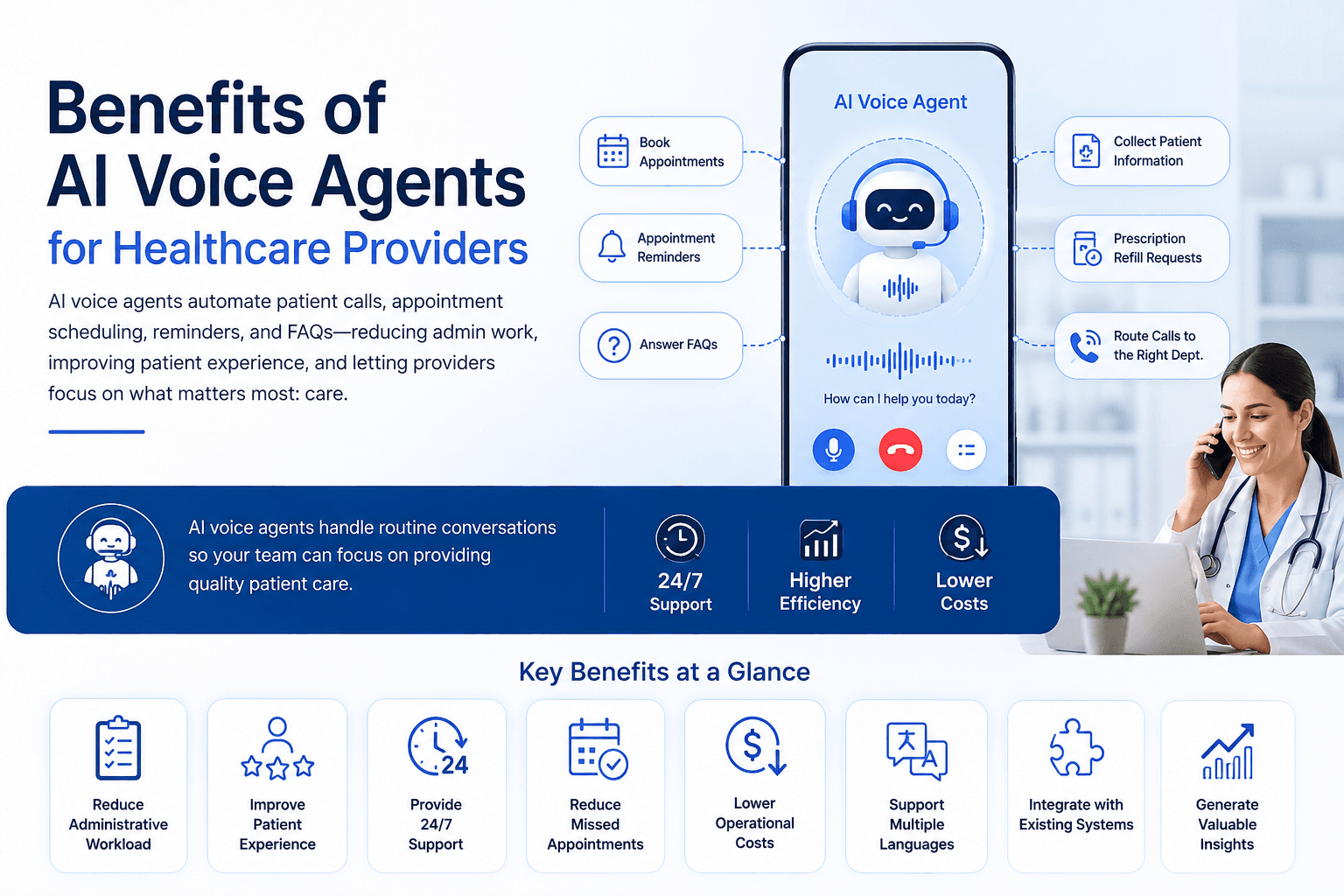
AI voice agents are transforming healthcare communication by automating these repetitive phone interactions through natural, human-like conversations. Unlike traditional IVR systems that rely on rigid menu options, AI voice agents understand patient intent, respond intelligently, and integrate with Electronic Health Records (EHR), Electronic Medical Records (EMR), scheduling platforms, and CRM systems to complete tasks in real time.
This guide explains how AI voice agents work, their key healthcare use cases, implementation best practices, business benefits, and how healthcare organizations can leverage them to improve patient experiences while reducing operational costs.
What Are AI Voice Agents in Healthcare?
An AI voice agent is an intelligent conversational assistant that communicates with patients over the phone using Artificial Intelligence (AI), Natural Language Processing (NLP), Automatic Speech Recognition (ASR), and Text-to-Speech (TTS) technologies. It can understand spoken language, identify patient intent, access integrated healthcare systems, and respond naturally without requiring human intervention for routine administrative tasks.
AI voice agents can automate tasks such as:
- Appointment scheduling
- Appointment rescheduling and cancellations
- Automated appointment reminders
- Patient intake and information collection
- Prescription refill requests
- Insurance and billing inquiries
- Frequently asked questions
- Post-visit follow-up calls
- After-hours patient support
- Intelligent call routing to healthcare staff
When patients require clinical advice, emergency assistance, or complex support, AI voice agents seamlessly transfer the call to the appropriate healthcare professional while providing relevant conversation context.
Why Healthcare Organizations Are Adopting AI Voice Agents
Healthcare organizations receive hundreds or even thousands of patient calls every day. Managing these conversations manually often leads to long wait times, missed calls, administrative bottlenecks, and staff burnout. As patient expectations continue to evolve, healthcare providers need scalable communication solutions that improve accessibility without increasing operational costs.
AI voice agents enable providers to automate repetitive administrative workflows while ensuring patients receive immediate assistance at any time of day. This allows front-desk teams to focus on high-value patient interactions instead of routine phone tasks.
Common challenges AI voice agents help solve include:
- High patient call volumes
- Long call wait times
- Missed appointments and no-shows
- Administrative staff shortages
- Limited after-hours support
- Increasing operational costs
- Repetitive patient inquiries
- Inconsistent patient experiences
How AI Voice Agents Work
AI voice agents combine multiple AI technologies to create natural conversations that closely resemble speaking with a human receptionist. When a patient calls, the system converts speech into text, understands the patient's request using Natural Language Processing, retrieves relevant information from connected healthcare systems, and responds using realistic AI-generated speech.
This enables healthcare providers to automate complex communication workflows while maintaining accurate patient records and delivering consistent service across every interaction.
A typical AI voice interaction includes:
- Answering incoming patient calls instantly
- Understanding patient intent using conversational AI
- Accessing appointment schedules and patient records
- Completing requested actions automatically
- Escalating urgent or complex conversations to staff
- Recording conversation insights for reporting and analytics
Key Benefits of AI Voice Agents in Healthcare
Implementing AI voice agents offers measurable benefits for healthcare organizations by improving operational efficiency while enhancing patient satisfaction.
- 24/7 patient communication without additional staffing
- Reduced administrative workload for front-desk teams
- Faster appointment scheduling and confirmations
- Lower missed appointment rates through automated reminders
- Improved patient satisfaction with immediate responses
- Scalable communication during peak call volumes
- Lower operational costs and increased staff productivity
- Seamless integration with EHR, EMR, CRM, and scheduling platforms
Healthcare Use Cases for AI Voice Agents
AI voice agents support a wide range of patient communication workflows across hospitals, clinics, specialty practices, telehealth providers, and diagnostic centers.
Popular healthcare use cases include:
- Appointment booking and calendar management
- Appointment reminders and confirmations
- Prescription refill requests
- Patient registration and intake
- Insurance eligibility verification
- Billing and payment assistance
- Post-treatment follow-up calls
- Patient satisfaction surveys
- Multilingual patient communication
- Emergency call routing and escalation
Conclusion
AI voice agents are transforming healthcare by automating routine patient communication while enabling healthcare professionals to focus on delivering exceptional care. From appointment scheduling and patient intake to follow-up calls and billing support, these intelligent systems improve efficiency, reduce costs, and enhance the overall patient experience.
As healthcare organizations continue their digital transformation journey, AI voice agents provide a scalable and future-ready solution for delivering faster, smarter, and more accessible patient communication. Providers that adopt AI voice technology today will be better positioned to meet growing patient expectations, optimize operations, and improve long-term business outcomes.
AI Voice Agent vs Traditional Healthcare Reception
| Feature | Traditional Reception | AI Voice Agent |
|---|---|---|
| Availability | Business hours only | 24/7 availability |
| Appointment Scheduling | Manual phone booking | Automated scheduling and rescheduling |
| Simultaneous Call Handling | One caller at a time | Handles multiple calls simultaneously |
| Patient Wait Time | Long during peak hours | Instant or minimal wait times |
| Appointment Reminders | Manual outbound calls | Automated reminder calls and confirmations |