
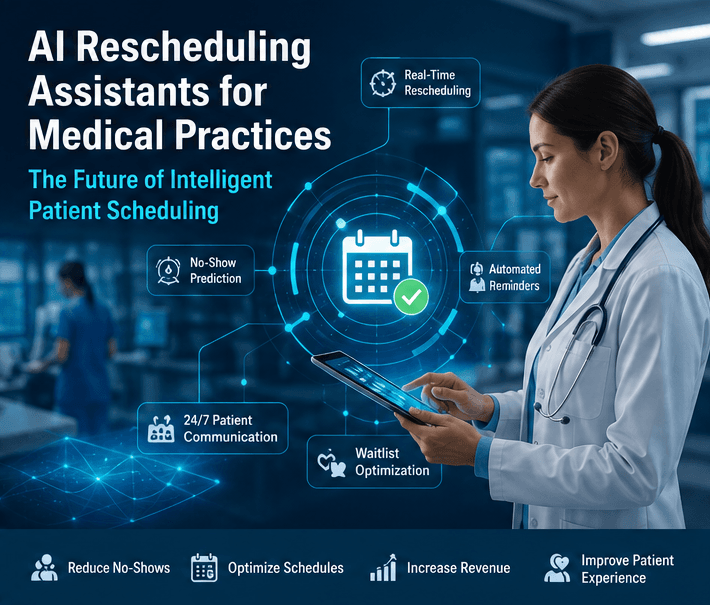
AI Rescheduling Assistants for Medical Practices: The Future of Intelligent Patient Scheduling
Walk into almost any busy medical practice at 9:00 AM on a Monday and you'll witness a familiar scene. Receptionists are answering multiple phone calls simultaneously. Patients are arriving for appointments while others are calling to cancel at the last minute. Physicians are asking whether an empty appointment slot can be filled. Someone from the waiting list wants an earlier consultation, another patient needs to reschedule because of work, and insurance verification is delaying several bookings.
Although healthcare has embraced digital transformation across diagnostics, medical imaging, electronic health records, and clinical decision support, appointment scheduling remains surprisingly manual. In many practices, highly trained administrative staff still spend several hours every day coordinating calendars, returning phone calls, leaving voicemail messages, updating scheduling systems, and trying to fill cancelled appointments before valuable physician time is lost.
This seemingly routine administrative process has enormous financial consequences.
A single unfilled specialist appointment may represent hundreds of dollars in lost revenue. Across an entire healthcare organization, recurring cancellations, no-shows, scheduling conflicts, and inefficient calendar management can result in thousands of lost appointment opportunities every month. Beyond financial losses, inefficient scheduling extends patient waiting times, delays diagnoses, contributes to physician burnout, and negatively affects the overall patient experience.
These operational challenges have become significantly more complex in recent years. Healthcare providers now manage hybrid care models combining in-person consultations, virtual appointments, remote monitoring, diagnostic imaging, specialist referrals, and multidisciplinary treatment pathways. Patients expect the same digital convenience they experience when booking flights, ordering groceries, or making restaurant reservations. They no longer want to spend fifteen minutes on hold simply to move an appointment by two days.
This growing gap between patient expectations and traditional scheduling processes has created one of the most compelling applications of Artificial Intelligence within healthcare operations: AI rescheduling assistants.
Unlike traditional appointment reminder software that performs only one-way communication, AI scheduling assistants actively participate in scheduling decisions. They understand natural language, communicate with patients through multiple channels, evaluate physician availability in real time, prioritize waiting lists, recommend optimal appointment slots, and synchronize every confirmed change across Electronic Health Record systems, Practice Management Software, patient portals, billing platforms, and communication tools.
In practical terms, an AI assistant functions like an experienced scheduling coordinator who never sleeps. It continuously monitors calendars, identifies opportunities to improve utilization, predicts scheduling risks, and engages patients whenever action is required. Whether a cancellation occurs at midnight or during peak clinic hours, the system immediately begins searching for the best replacement opportunity without requiring staff intervention.
The technology behind these assistants has advanced rapidly over the past two years due to breakthroughs in large language models, conversational AI, speech recognition, predictive analytics, and workflow automation platforms. Modern AI assistants are capable of understanding complex scheduling requests such as, "I'd like the earliest cardiology appointment after next Wednesday but before my MRI," while simultaneously respecting physician availability, appointment duration, insurance requirements, equipment constraints, and patient preferences.
For healthcare administrators, the value extends well beyond convenience. Intelligent scheduling directly influences operational efficiency, physician productivity, patient retention, resource allocation, and revenue optimization. Instead of allowing cancellations to create idle clinical capacity, AI continuously works to maximize appointment utilization across the organization.
This evolution marks a significant shift in how healthcare organizations approach administrative automation. Rather than replacing human staff, AI eliminates repetitive coordination tasks that consume valuable administrative hours every day. Receptionists and scheduling coordinators can redirect their attention toward higher-value responsibilities requiring empathy, judgment, and personalized patient support.
Healthcare's Scheduling Crisis Is Bigger Than Most Organizations Realize
When healthcare executives discuss digital transformation, conversations often focus on clinical technologies such as AI-assisted diagnostics, robotic surgery, predictive medicine, or medical imaging. Administrative workflows rarely receive the same attention despite representing one of the largest sources of operational inefficiency.
Appointment scheduling sits at the center of nearly every patient journey. Every consultation, diagnostic procedure, follow-up visit, specialist referral, laboratory test, and preventive screening depends on effective scheduling. A single scheduling failure can trigger delays throughout the entire continuum of care.
What appears to be a minor administrative inconvenience often creates a cascading operational problem. A cancelled appointment may leave a physician idle for thirty minutes. That unused slot could have accommodated a patient waiting several weeks for care. Delayed appointments increase patient frustration, extend treatment timelines, reduce provider productivity, and ultimately affect both financial performance and clinical outcomes.
Why Traditional Appointment Scheduling Is Failing Modern Medical Practices
Healthcare has evolved dramatically over the past decade, but appointment scheduling in many clinics still follows workflows that were designed twenty years ago. Patients call during office hours, receptionists manually search for available slots, appointments are entered into the practice management system, reminders are sent, and if someone cancels, the entire process begins again.
This workflow appears manageable when a clinic handles twenty appointments per day. However, as organizations grow into multi-provider practices, specialty centers, or healthcare networks managing hundreds of daily appointments, manual scheduling quickly becomes one of the largest operational bottlenecks.
Every cancellation creates a ripple effect throughout the clinic. Staff members pause their current work to contact patients on waiting lists. Some patients do not answer. Others request different dates. Some physicians have unique scheduling requirements. Certain procedures require specific examination rooms or equipment, while insurance authorizations introduce additional constraints.
Instead of focusing on patient care, administrative teams spend a significant portion of their working hours acting as human scheduling engines.
The problem is not a lack of effort. Most scheduling teams are remarkably efficient. The challenge is that humans simply cannot continuously optimize hundreds of appointments while responding instantly to changing calendars, patient preferences, provider availability, and operational priorities.
Artificial intelligence approaches this challenge differently. Rather than reacting to scheduling changes, AI continuously evaluates every appointment, predicts scheduling risks, identifies optimization opportunities, and recommends actions before operational problems become visible.
The Hidden Financial Cost of Missed Appointments
When people think about no-shows, they often imagine a single empty examination room. From a business perspective, the impact is considerably larger.
Every unused appointment represents multiple forms of loss occurring simultaneously.
- Lost consultation revenue.
- Reduced physician utilization.
- Underused clinical facilities.
- Longer waiting lists.
- Delayed treatment.
- Lower patient satisfaction.
- Administrative time spent rescheduling.
- Reduced operational efficiency.
Imagine a specialty cardiology clinic where an appointment worth $300 is cancelled thirty minutes before the scheduled consultation. The physician remains available, the examination room remains prepared, and clinical staff remain allocated. Unless another patient can be contacted immediately, that capacity disappears forever.
Multiply this scenario across several physicians, multiple clinic locations, and an entire year, and the financial impact becomes substantial.
For large healthcare systems, appointment utilization is no longer simply an operational metric. It has become a direct indicator of revenue optimization, workforce productivity, and patient access.
This is precisely where AI rescheduling assistants create measurable business value. Their objective is not merely to move appointments around the calendar. Their primary goal is maximizing the utilization of every available clinical minute.
Why Existing Scheduling Software Is No Longer Enough
Most medical practices already use appointment scheduling software. Systems such as Electronic Health Records (EHR), Practice Management Systems (PMS), and patient portals provide digital calendars and online booking capabilities.
However, digitization should not be confused with automation.
Traditional scheduling platforms typically perform three primary functions.
- Store appointments.
- Display provider calendars.
- Send automated reminders.
These capabilities certainly improve organization compared to paper calendars, but they remain fundamentally passive systems.
When a patient cancels, conventional software usually waits for a human to decide what happens next.
AI scheduling assistants behave differently.
The moment a cancellation occurs, the assistant immediately begins evaluating hundreds of scheduling possibilities. It identifies patients waiting for earlier appointments, considers provider preferences, verifies appointment duration, checks insurance requirements, evaluates room availability, predicts patient response probability, and begins contacting the most suitable candidates automatically.
Instead of displaying information, AI actively manages scheduling operations.
This distinction represents one of the biggest differences between workflow automation and artificial intelligence.
Changing Patient Expectations Are Driving AI Adoption
Healthcare is no longer competing solely against other healthcare providers. Patients compare every digital interaction with the experiences they receive from airlines, hotels, banking applications, food delivery platforms, and online retailers.
Consumers have become accustomed to instant confirmation, self-service booking, personalized recommendations, and real-time notifications.
When patients can modify international flight reservations within seconds using a smartphone, waiting on hold for fifteen minutes simply to reschedule a doctor's appointment feels unnecessarily outdated.
This expectation gap continues to widen, particularly among younger patient populations who increasingly prefer digital communication over telephone conversations.
AI rescheduling assistants satisfy these expectations by enabling patients to interact through channels they already use every day.
- SMS conversations.
- Email.
- Patient portals.
- Mobile applications.
- Voice AI phone calls.
- Website chatbots.
- Messaging platforms.
Patients are free to respond whenever convenient rather than being restricted to clinic operating hours. Whether someone needs to reschedule at 6:30 in the morning or 11:45 at night, the assistant remains available.
This twenty-four-hour availability significantly improves patient convenience while simultaneously reducing inbound call volume for administrative teams.
How AI Rescheduling Assistants Think Differently
The defining characteristic of an AI rescheduling assistant is not automation alone. It is decision-making.
Instead of following rigid if-then rules, modern AI systems evaluate multiple variables simultaneously before recommending the most appropriate scheduling action.
For example, consider the following scenario.
A dermatologist receives a cancellation for a ninety-minute surgical procedure scheduled for tomorrow afternoon.
Rather than simply notifying staff, the AI assistant evaluates:
- Patients currently waiting for earlier appointments.
- Procedure compatibility.
- Insurance approval status.
- Required surgical equipment.
- Physician specialization.
- Patient travel distance.
- Historical response times.
- Likelihood of attendance.
- Previous cancellations.
- Calendar utilization across the entire practice.
After analyzing these variables, the assistant ranks the most appropriate candidates, initiates personalized outreach, confirms availability through conversational AI, updates every connected scheduling system, sends confirmation messages, modifies reminder workflows, and informs staff only after the appointment has been successfully filled.
What previously required multiple employees making dozens of phone calls can often be completed within a few minutes.
Beyond Scheduling: AI Becomes an Operational Intelligence Layer
The most advanced AI scheduling assistants are evolving beyond appointment management into comprehensive operational intelligence platforms.
Every patient interaction generates valuable data that continuously improves future scheduling decisions.
Over time, AI begins identifying behavioral patterns such as:
- Patients who frequently reschedule Monday morning appointments.
- Appointment types associated with higher cancellation rates.
- Physicians whose calendars consistently develop afternoon gaps.
- Seasonal fluctuations in patient demand.
- Communication channels producing the fastest patient responses.
- Appointment durations that regularly exceed planned schedules.
- Specialties experiencing growing waiting lists.
- A patient cancels online.
- A physician blocks additional consultation hours.
- A surgery extends beyond its expected duration.
- An emergency appointment is inserted into the schedule.
- A patient requests rescheduling through SMS.
- A receptionist manually modifies an appointment.
- Appointment type.
- Consultation duration.
- Medical specialty.
- Provider preferences.
- Room availability.
- Equipment requirements.
- Insurance authorization status.
- Patient communication preferences.
- Clinical urgency.
- Travel distance.
- Previous scheduling history.
- Follow-up dependencies.
- Clinical urgency.
- Length of time already waiting.
- Appointment compatibility.
- Historical attendance rate.
- Probability of accepting an earlier slot.
- Preferred appointment times.
- Geographic proximity.
- Language preferences.
- Insurance compatibility.
- Updates the appointment calendar.
- Modifies the physician schedule.
- Synchronizes the Electronic Health Record.
- Updates the patient portal.
- Triggers confirmation messages.
- Adjusts reminder schedules.
- Logs communication history.
- Notifies administrative staff.
- Updates reporting dashboards.
- I need to move my appointment.
- Can I come another day?
- Tomorrow doesn't work anymore.
- I have a meeting that afternoon.
- I won't be able to make it.
- Date: Tuesday.
- Preferred time: Evening.
- Appointment action: Reschedule.
- Cancel appointments.
- Miss consultations.
- Accept earlier appointments.
- Respond quickly to SMS.
- Prefer voice calls.
- Require additional reminders.
- Physician utilization.
- Patient convenience.
- Clinic revenue.
- Room occupancy.
- Equipment usage.
- Staff efficiency.
- Waiting list reduction.
- Appointment completion rates.
- 60 appointments were cancelled daily.
- Only about half of those appointments were successfully refilled.
- Patients waited up to three weeks for specialist consultations despite frequent cancellations.
- Treatment room availability.
- Required dental equipment.
- Procedure duration.
- Assistant availability.
- Patient treatment history.
- Follow-up scheduling requirements.
- Equipment availability.
- Scan duration.
- Radiologist schedules.
- Preparation requirements.
- Contrast administration needs.
- Patient fasting instructions.
- Insurance authorization.
- Previous attendance history.
- Lead time between booking and appointment.
- Appointment timing.
- Weather conditions.
- Distance from the clinic.
- Communication responsiveness.
- Appointment type.
- Electronic Health Records (EHR).
- Practice Management Systems (PMS).
- Patient Relationship Management (CRM) platforms.
- Billing and insurance systems.
- Patient portals.
- SMS gateways.
- Email platforms.
- Voice communication systems.
- Calendar applications.
- Telehealth platforms.
- Large Language Models (LLMs) for conversational understanding.
- Natural Language Processing (NLP) for extracting scheduling intent.
- Speech-to-Text and Text-to-Speech systems for voice interactions.
- Predictive Machine Learning models for no-show forecasting.
- Workflow automation platforms for orchestrating business processes.
- Vector databases for contextual memory.
- Retrieval-Augmented Generation (RAG) for accessing clinic policies and scheduling rules.
- API orchestration for secure integration with healthcare systems.
- Average no-show rate.
- Cancellation rate.
- Average patient wait time.
- Appointment utilization percentage.
- Front desk call volume.
- Average rescheduling time.
- Administrative hours spent on scheduling.
- Provider idle time.
- Electronic Health Records (EHR).
- Practice Management Software.
- Patient Portal.
- CRM Platform.
- SMS Gateway.
- Email Service.
- Voice Calling Platform.
- Calendar System.
- Minimum appointment notice.
- Provider-specific availability.
- Consultation duration.
- Emergency scheduling priority.
- Insurance restrictions.
- Equipment requirements.
- Location-specific calendars.
- Working hours.
- Legacy software integrations.
- Incomplete patient contact information.
- Staff training requirements.
- Complex scheduling policies.
- Patient adoption of digital communication.
- Data privacy and compliance requirements.
- Workflow redesign.
- Begin with one department before scaling.
- Keep human staff available for complex scheduling situations.
- Continuously monitor scheduling performance metrics.
- Regularly retrain predictive models using new scheduling data.
- Offer patients multiple communication channels.
- Measure patient satisfaction alongside operational KPIs.
- Review AI recommendations periodically to ensure clinical appropriateness.
These insights allow healthcare administrators to improve staffing, physician allocation, clinic operating hours, resource planning, and long-term scheduling strategies.
Instead of asking, "Who cancelled today's appointment?", organizations begin asking, "What operational patterns can AI identify that help us prevent cancellations before they happen?"
From Administrative Automation to Revenue Optimization
One of the biggest misconceptions surrounding healthcare automation is that its primary purpose is reducing administrative workload. While fewer manual scheduling tasks certainly improve efficiency, the broader business objective is maximizing healthcare capacity.
Every examination room, physician hour, diagnostic device, and consultation slot represents a valuable operational asset. Empty capacity cannot be recovered once the day ends.
AI rescheduling assistants therefore shift the focus from reactive scheduling toward proactive revenue optimization. They continuously search for opportunities to match available clinical capacity with patient demand, ensuring providers spend more time delivering care and less time waiting for the next appointment.
This transformation is why AI scheduling has rapidly become one of the highest-return healthcare automation investments. It simultaneously improves patient access, physician productivity, operational efficiency, administrative performance, and financial outcomes without compromising the quality of patient care.
How AI Rescheduling Assistants Work: The Technology Behind Intelligent Medical Scheduling
From the patient's perspective, an AI rescheduling assistant appears remarkably simple. A patient receives a text message or phone call asking whether they would like to move their appointment to an earlier time. They reply naturally, confirm the new slot, and within seconds the clinic calendar is updated.
Behind this seemingly straightforward interaction lies a sophisticated ecosystem of artificial intelligence models, workflow automation, predictive analytics, healthcare integrations, and real-time decision engines working together.
Unlike traditional scheduling software that waits for human instructions, AI assistants continuously monitor scheduling events across the organization. Every cancellation, delayed physician, emergency booking, new referral, or change in provider availability becomes an opportunity for the AI to optimize clinic operations.
Instead of asking, "What happened?", the AI immediately asks, "What is the best possible action now?"
The End-to-End AI Scheduling Workflow
A modern AI rescheduling assistant follows an intelligent workflow designed to maximize provider utilization while minimizing administrative effort.
Step 1: Continuous Calendar Monitoring
The AI continuously monitors appointment calendars through integrations with Electronic Health Record (EHR) systems, Practice Management Software (PMS), scheduling platforms, and patient portals.
Rather than checking calendars every few minutes, event-driven systems receive notifications the instant something changes.
Examples include:
The AI immediately begins evaluating the operational impact.
Step 2: Understanding the Scheduling Context
Not every appointment can simply be moved to another empty slot.
The assistant analyzes dozens of scheduling variables before recommending any action.
These include:
Instead of looking for the first available slot, AI identifies the most appropriate appointment opportunity for both the provider and the patient.
Step 3: Prioritizing Replacement Patients
One of the biggest advantages of AI scheduling assistants is intelligent waitlist management.
Traditional clinics often maintain spreadsheets or handwritten waiting lists that quickly become outdated.
AI transforms waiting lists into dynamic prioritization systems.
When an appointment becomes available, the assistant automatically scores every eligible patient.
The scoring model considers factors such as:
Rather than contacting fifty patients manually, the assistant immediately identifies the five patients with the highest likelihood of accepting the appointment.
Step 4: Conversational Patient Outreach
This is where modern conversational AI significantly outperforms traditional appointment reminder systems.
Instead of sending generic reminders, AI initiates natural conversations.
For example:
Hello Sarah. A consultation with Dr. Patel has become available tomorrow at 2:30 PM. Would you like to move your appointment from next Thursday?
The patient might respond:
Can you offer something after 4 PM instead?
The AI understands the request, searches for alternative appointments, and replies with appropriate options.
We have availability at 4:15 PM tomorrow or 5:00 PM on Friday. Which would you prefer?
Unlike rule-based chatbots that require predefined button selections, modern Large Language Models understand natural human conversations containing incomplete sentences, spelling mistakes, conversational language, and follow-up questions.
Step 5: Real-Time Decision Making
Once the patient confirms the appointment, the AI simultaneously performs multiple operational tasks.
Processes that previously required several software systems and multiple employees now occur automatically within seconds.
The Core Technologies Behind AI Rescheduling Assistants
Several artificial intelligence technologies work together to create a seamless scheduling experience.
Large Language Models (LLMs)
Large Language Models enable assistants to understand conversational scheduling requests without relying on predefined scripts.
Instead of interpreting exact keywords, LLMs understand meaning.
For example, all of the following requests represent the same scheduling intent:
The assistant recognizes these as rescheduling requests and responds appropriately.
Natural Language Processing (NLP)
Natural Language Processing extracts useful scheduling information from conversations.
For example:
"I'd like something after work next Tuesday."
The AI converts this into structured scheduling constraints:
This allows scheduling engines to search calendars automatically without requiring structured form inputs.
Predictive Analytics
Predictive machine learning models analyze historical appointment data to estimate future scheduling behavior.
The models may identify patients who are statistically more likely to:
These predictions allow healthcare providers to intervene before operational problems occur.
Optimization Algorithms
Scheduling is fundamentally an optimization problem.
The AI evaluates thousands of possible scheduling combinations while balancing numerous operational constraints.
Its objective is not simply finding available time.
Instead, it attempts to maximize:
Real-World Example: A Multi-Specialty Clinic
Consider a healthcare organization with twenty physicians operating across cardiology, dermatology, orthopedics, endocrinology, and family medicine.
The clinic manages approximately 600 appointments each day.
Historically, the administrative team consisted of eight scheduling coordinators who collectively spent most of their working hours handling appointment modifications.
On average:
After implementing an AI rescheduling assistant integrated with the clinic's scheduling software, patient portal, SMS platform, and voice AI system, the workflow changed dramatically.
Whenever a cancellation occurred, the AI immediately identified the highest-priority patients, contacted them automatically, confirmed new appointments through conversational messaging, updated every connected system, and informed staff only after successful completion.
Within months, administrative staff spent considerably less time making outbound scheduling calls. Physicians experienced fewer gaps between appointments, patients received earlier consultations, and waiting lists moved significantly faster.
The technology did not replace receptionists. Instead, it removed repetitive scheduling work, allowing staff to focus on patient interactions that genuinely required human judgment and empathy.
Why This Matters for the Future of Healthcare
Healthcare organizations are increasingly recognizing that artificial intelligence delivers its greatest value not only inside examination rooms but also throughout operational workflows.
Clinical excellence depends on operational excellence. Every unnecessary administrative delay affects patient outcomes, provider productivity, and financial sustainability.
AI rescheduling assistants represent one of the clearest examples of how intelligent automation improves both business performance and patient care simultaneously. Rather than viewing scheduling as an administrative necessity, leading healthcare organizations are beginning to treat it as a strategic capability powered by artificial intelligence.
Real-World Applications of AI Rescheduling Assistants Across Different Medical Specialties
While the core functionality of an AI rescheduling assistant remains consistent, its real value becomes evident when adapted to the unique scheduling requirements of different medical specialties. Every healthcare practice operates under distinct clinical workflows, appointment durations, patient demographics, and resource constraints. A family medicine clinic faces very different scheduling challenges than a dental practice or an orthopedic surgery center. Modern AI assistants are designed to understand these nuances and optimize scheduling accordingly.
Instead of applying a one-size-fits-all scheduling strategy, AI continuously learns the operational characteristics of each specialty, making recommendations that align with clinical priorities, provider availability, and patient needs.
Primary Care Clinics
Primary care physicians often manage the highest appointment volumes within a healthcare system. Daily schedules typically include preventive health visits, chronic disease management, vaccinations, acute illnesses, annual physical examinations, and follow-up consultations.
Even a handful of unexpected cancellations can create significant disruptions throughout the day.
An AI rescheduling assistant continuously monitors appointment availability and immediately contacts patients who have requested earlier appointments. Because primary care appointments are generally standardized in duration, AI can quickly fill vacant slots without requiring manual review.
The result is improved physician utilization, reduced patient waiting times, and fewer idle consultation rooms.
Dental Practices
Dental scheduling presents unique operational challenges because procedures often require specialized equipment, treatment rooms, assistants, and varying appointment durations.
A missed two-hour dental procedure affects not only the dentist but also hygienists, assistants, and equipment utilization.
AI scheduling assistants consider:
If a patient cancels a lengthy restorative procedure, the AI identifies another patient awaiting similar treatment rather than filling the slot with a short consultation that would leave significant unused clinical capacity.
Specialist Practices
Cardiology, neurology, oncology, endocrinology, gastroenterology, dermatology, and orthopedic clinics frequently experience long waiting lists due to limited specialist availability.
In these environments, every cancelled appointment represents a missed opportunity to improve patient access.
Rather than allowing valuable specialist time to remain unused, AI assistants automatically prioritize patients based on clinical urgency, referral status, diagnostic requirements, and historical scheduling data.
This intelligent prioritization enables practices to shorten waiting lists without increasing physician workload.
Diagnostic Imaging Centers
MRI scanners, CT machines, ultrasound suites, and other imaging equipment represent some of the most expensive operational assets within healthcare.
Every unused imaging appointment directly impacts equipment utilization and revenue generation.
AI scheduling assistants optimize diagnostic scheduling by considering:
When cancellations occur, the assistant immediately identifies patients whose examinations meet all scheduling requirements, maximizing utilization of high-value diagnostic equipment.
Mental Health Practices
Mental health providers face unique scheduling considerations because continuity of care plays a critical role in treatment outcomes.
Patients often prefer recurring appointment times with the same therapist, making manual scheduling increasingly complex as practices expand.
AI assistants preserve continuity while identifying opportunities to accommodate patient preferences, reduce cancellations, and maintain consistent treatment schedules.
Key Capabilities That Differentiate Modern AI Rescheduling Assistants
Not every scheduling solution marketed as "AI-powered" delivers true artificial intelligence capabilities. Many platforms simply automate reminder messages or provide online booking functionality.
A modern AI rescheduling assistant should combine conversational intelligence, predictive analytics, workflow automation, and real-time decision-making into a unified platform.
Dynamic Waitlist Automation
Traditional waiting lists are static. Staff manually review names whenever appointments become available.
AI replaces this process with continuously updated intelligent waitlists.
Every patient receives a dynamic priority score based on clinical urgency, provider compatibility, preferred appointment times, previous interactions, and acceptance probability.
As circumstances change, these rankings automatically update without human intervention.
Predictive No-Show Detection
One of the most valuable applications of machine learning in scheduling is predicting appointment attendance before the appointment occurs.
Using historical scheduling data, predictive models evaluate variables such as:
Patients identified as high-risk may automatically receive additional reminders, personalized confirmation requests, or proactive rescheduling options before becoming no-shows.
Omnichannel Patient Communication
Modern patients communicate differently.
Some prefer text messages.
Others answer phone calls.
Some respond only through patient portals or email.
AI scheduling assistants intelligently determine the most effective communication channel for each patient based on historical engagement patterns.
Instead of sending identical reminders to everyone, communication becomes personalized and adaptive.
Voice AI Scheduling
Advancements in conversational voice technology now allow AI assistants to conduct realistic telephone conversations with patients.
Patients no longer navigate complicated phone menus.
Instead, they simply speak naturally.
"I'd like to reschedule because my flight was delayed."
The AI understands the context, searches available appointments, confirms the patient's preferred option, and updates every connected healthcare system in real time.
This significantly reduces inbound call volume while providing a more natural patient experience.
Essential Integrations for Successful Implementation
An AI scheduling assistant delivers its greatest value when integrated across the healthcare technology ecosystem rather than operating as a standalone application.
Common integrations include:
These integrations ensure every scheduling action is synchronized across the organization, eliminating duplicate data entry and reducing administrative errors.
Leading AI Technologies Powering Healthcare Scheduling
Several enterprise AI technologies are commonly used when building intelligent scheduling assistants. Rather than relying on a single model, modern implementations combine multiple specialized technologies.
Together, these technologies create assistants capable of understanding patient conversations, reasoning through scheduling constraints, retrieving relevant operational information, and executing complex workflows without manual intervention.
Why Healthcare Organizations Are Investing in AI Scheduling Today
Healthcare leaders increasingly recognize that sustainable growth depends not only on attracting more patients but also on maximizing the efficiency of existing clinical capacity.
Hiring additional administrative staff may temporarily reduce scheduling pressure, but it does not fundamentally solve the underlying operational complexity.
AI scheduling assistants provide a scalable alternative by automating repetitive administrative processes while enabling existing teams to focus on higher-value patient interactions.
As patient expectations continue evolving and healthcare systems face growing workforce shortages, intelligent scheduling is rapidly shifting from a competitive advantage to an operational necessity. Organizations investing today are not simply adopting another software platform, they are building the digital infrastructure required to deliver faster, more efficient, and more patient-centered healthcare in the years ahead.
Implementation Roadmap: How to Successfully Deploy an AI Rescheduling Assistant
Implementing an AI rescheduling assistant is not simply a technology upgrade. It is an operational transformation that affects patient communication, scheduling workflows, administrative processes, and clinical efficiency. Organizations that achieve the highest return on investment typically follow a phased implementation strategy rather than attempting to automate every scheduling process simultaneously.
The objective should be to enhance existing workflows while minimizing disruption for staff and patients.
Phase 1: Analyze Current Scheduling Operations
Before introducing artificial intelligence, healthcare organizations should establish a clear understanding of their current scheduling performance.
Important baseline metrics include:
These metrics establish a benchmark against which future improvements can be measured.
Phase 2: Integrate Existing Healthcare Systems
The AI assistant should integrate directly with the systems already used by the practice rather than replacing them.
A typical implementation connects:
This unified architecture ensures that every appointment update is reflected consistently across the organization.
Phase 3: Configure Scheduling Rules
Every medical practice follows different operational policies.
The AI must understand these rules before making scheduling decisions.
Typical business rules include:
These rules allow the AI to make recommendations that align with real clinical operations.
Phase 4: Pilot Deployment
Most organizations begin with a single physician, department, or clinic location.
This controlled rollout enables teams to evaluate performance, gather staff feedback, and fine-tune conversational workflows before expanding across the organization.
Phase 5: Organization-Wide Rollout
After successful validation, AI scheduling capabilities can be expanded across specialties, providers, and clinic locations while maintaining centralized reporting and governance.
Expected Return on Investment
Although implementation costs vary depending on organization size, healthcare providers generally experience measurable operational improvements within the first few months.
| Performance Indicator | Typical Improvement |
|---|---|
| Administrative Scheduling Time | 40% to 70% reduction |
| Appointment Utilization | 10% to 20% increase |
| No-Show Rate | 15% to 35% reduction |
| Patient Waiting Time | 20% to 40% reduction |
| Inbound Scheduling Calls | 30% to 60% reduction |
| Front Desk Productivity | Significant improvement |
While exact results vary, these improvements often translate into higher physician productivity, improved patient access, and stronger financial performance.
Challenges Organizations Should Prepare For
Like every enterprise AI initiative, successful implementation depends on thoughtful planning rather than technology alone.
Healthcare organizations should anticipate several common challenges.
Organizations that involve physicians, administrative staff, IT teams, and operational leadership early in the implementation process generally achieve faster adoption and better long-term outcomes.
Best Practices for Maximizing Success
The Future of AI Rescheduling Assistants
The next generation of healthcare scheduling will extend well beyond appointment management.
Future AI assistants will coordinate complete patient journeys, automatically scheduling consultations, laboratory tests, imaging appointments, specialist referrals, follow-up visits, telehealth sessions, prescription renewals, and post-treatment monitoring through a single intelligent workflow.
Rather than functioning as isolated scheduling tools, AI assistants will become digital care coordinators capable of optimizing every interaction between patients, providers, and healthcare organizations.
Advances in multimodal AI, autonomous agents, predictive analytics, and healthcare interoperability standards will enable scheduling systems to anticipate patient needs before appointments are even requested.
Conclusion
Appointment scheduling has evolved from a routine administrative task into a strategic business function that directly influences patient satisfaction, operational efficiency, physician productivity, and healthcare revenue.
AI rescheduling assistants represent one of the most practical and impactful applications of artificial intelligence within healthcare operations. By combining conversational AI, predictive analytics, workflow automation, and intelligent decision-making, these systems transform scheduling from a reactive process into a proactive operational advantage.
Healthcare organizations that invest in intelligent scheduling today are building the digital foundation for more efficient, accessible, and patient-centric care. As AI capabilities continue advancing, intelligent scheduling will become an essential component of modern medical practice rather than an optional technology investment.
Ready to Transform Your Medical Practice with AI?
If your healthcare organization is struggling with appointment cancellations, scheduling inefficiencies, rising administrative workloads, or increasing patient expectations, an AI rescheduling assistant can deliver measurable improvements in both operational efficiency and patient experience.
Whether you operate a private clinic, multi-specialty practice, diagnostic center, dental clinic, or hospital network, implementing intelligent scheduling is one of the fastest ways to modernize healthcare operations while maximizing the value of every available appointment.
Key Takeaways
- •AI scheduling assistants reduce manual administrative work by automating appointment changes.
- •Conversational AI enables patients to reschedule through voice, SMS, email, and chat.
- •Predictive analytics identifies patients likely to miss appointments.
- •Dynamic waitlists automatically fill cancelled appointment slots.
- •Healthcare providers improve appointment utilization and reduce scheduling gaps.
- •AI integrates with EHR, PMS, and CRM systems for real-time synchronization.
- •Medical practices improve patient satisfaction while reducing operational costs.
- •AI scheduling delivers one of the highest ROI opportunities in healthcare automation.
Feature Comparison Analysis
| Feature | Traditional Medical Scheduling | AI Rescheduling Assistant |
|---|---|---|
| Appointment Rescheduling | Performed manually by front desk staff through phone calls and calendar updates. | Automatically handled using conversational AI across voice, SMS, email and patient portals. |
| Waitlist Management | Static lists reviewed manually whenever appointments become available. | Dynamic AI-powered waitlists that automatically prioritize and contact eligible patients. |
| No-show Prevention | Generic appointment reminders with limited personalization. | Generic appointment reminders with limited personalization. |
| Patient Communication | Limited to office hours and manual phone calls. | Limited to office hours and manual phone calls. |
| Calendar Optimization | Dependent on administrative staff availability. | Continuously optimized in real time using scheduling intelligence. |
| Provider Utilization | Appointment gaps frequently remain unfilled. | Cancelled appointments are automatically offered to the most suitable patients. |
| Operational Insights | Limited reporting with manual analysis. | AI generates predictive insights, scheduling analytics and optimization recommendations. |
| Scalability | Requires hiring additional administrative staff. | Supports multiple providers and clinic locations with minimal operational overhead. |