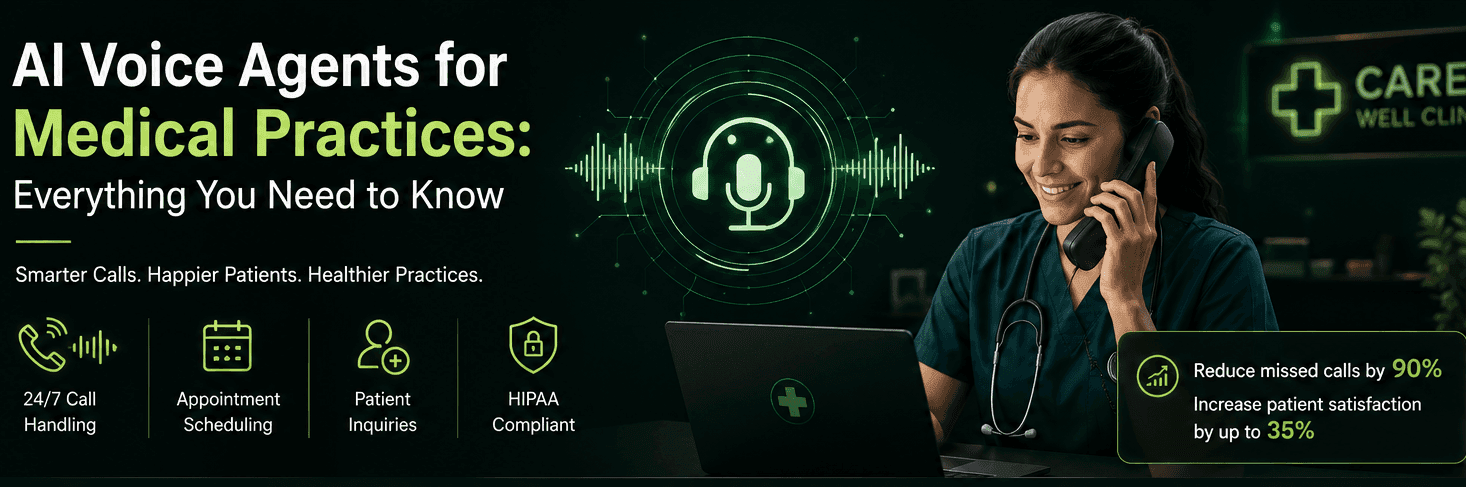
Why AI Voice Agents Are Becoming Essential for Modern Medical Practices
Healthcare has entered an era where patient experience is no longer defined only by clinical excellence. The first interaction a patient has with a medical practice often happens over the phone, and that interaction can determine whether they schedule an appointment, seek treatment elsewhere, or leave with a negative impression of the organization.
Unfortunately, many clinics continue to struggle with unanswered calls, overwhelmed front-desk teams, long hold times, and increasing administrative workloads. As patient expectations continue to rise, these operational bottlenecks directly affect revenue, patient satisfaction, and staff productivity.
This is precisely where AI voice agents for medical practices are creating measurable business value. Powered by conversational AI, natural language processing (NLP), speech recognition, and large language models (LLMs), these intelligent assistants communicate with patients naturally while completing administrative tasks in real time.
Unlike traditional IVR systems that force callers through frustrating "Press 1" menus, AI voice agents understand natural conversations.
Patient: "I'd like to see Dr. Wilson sometime next week."
AI Voice Agent: "Certainly. Dr. Wilson has availability on Tuesday at 11:00 AM and Thursday at 2:30 PM. Which works better for you?"
The interaction feels remarkably similar to speaking with an experienced receptionist, except it happens instantly, 24 hours a day, without placing patients on hold.
The Administrative Challenges Facing Healthcare Today
Medical practices are experiencing unprecedented operational pressure. Patient demand continues to increase while administrative staffing remains one of the industry's biggest challenges.
According to multiple healthcare workforce reports, administrative teams spend a significant portion of their day performing repetitive communication tasks rather than supporting patients inside the clinic. These repetitive activities often include appointment scheduling, insurance verification, prescription refill requests, billing questions, appointment reminders, and general inquiries.
As clinics grow, the volume of inbound phone calls grows even faster.
- Patients expect immediate responses.
- Many calls arrive simultaneously during peak hours.
- Staff members frequently place callers on hold.
- Missed calls often translate directly into lost appointments.
- Administrative burnout continues to increase across healthcare organizations.
AI voice automation addresses these challenges by handling repetitive conversations automatically while seamlessly transferring clinically sensitive or complex cases to human staff.
What Makes Modern AI Voice Agents Different?
The healthcare industry has experimented with automated phone systems for decades. However, traditional Interactive Voice Response (IVR) platforms relied on fixed decision trees and rigid call flows. Patients were expected to adapt to the system instead of the system adapting to the patient.
Today's AI voice agents operate very differently.
Instead of recognizing only predefined commands, they understand conversational intent. Patients can interrupt, ask follow-up questions, change topics, or speak naturally without breaking the conversation.
Behind the scenes, several AI technologies work together simultaneously.
- Automatic Speech Recognition (ASR) converts speech into text.
- Natural Language Processing (NLP) identifies patient intent.
- Large Language Models (LLMs) generate intelligent responses.
- Text-to-Speech (TTS) produces natural, human-like voices.
- Workflow automation connects the conversation with scheduling software, EHR systems, billing platforms, and CRM applications.
This combination allows an AI voice agent to complete entire administrative workflows during a single phone conversation instead of simply answering questions.
Real-World Use Cases That Deliver Immediate ROI
The most successful healthcare organizations begin by automating high-volume administrative workflows before expanding into more advanced patient engagement scenarios.
1. Intelligent Appointment Scheduling
Appointment scheduling remains the most common use case because it produces immediate operational improvements. Instead of waiting for a receptionist, patients can book appointments instantly, even outside business hours.
- Check physician availability in real time.
- Recommend suitable appointment slots.
- Confirm bookings automatically.
- Send SMS or email confirmations.
- Update scheduling software instantly.
For practices handling hundreds of weekly appointments, even a modest improvement in booking efficiency can significantly increase provider utilization and monthly revenue.
2. Automated Appointment Reminders and Rescheduling
Missed appointments represent one of the largest hidden costs in healthcare operations. AI voice agents proactively contact patients before scheduled visits, confirm attendance, answer preparation questions, and offer alternative appointment times when necessary.
Instead of manually calling every patient, staff members supervise the process while AI completes thousands of reminder conversations automatically.
Practices implementing intelligent reminder workflows frequently report measurable reductions in no-show rates alongside improved patient engagement.
How AI Voice Agents Transform Every Stage of the Patient Journey
The most successful AI implementations do not focus on replacing employees. Instead, they remove repetitive work that prevents staff from delivering exceptional patient care. Modern AI voice agents support nearly every administrative touchpoint in the patient journey, from the first phone call to post-treatment follow-ups.
When integrated with Electronic Health Records (EHR), Practice Management Systems (PMS), Customer Relationship Management (CRM) software, and communication platforms, these agents become intelligent operational assistants rather than standalone chatbots.
Insurance Verification Before Every Appointment
Insurance verification is one of the most time-consuming administrative tasks in healthcare. Manual verification requires staff to collect patient information, communicate with insurance providers, validate eligibility, and resolve discrepancies before appointments begin.
AI voice agents streamline this process by collecting insurance details during patient conversations and triggering automated eligibility verification workflows. If missing information is detected, patients can be notified immediately instead of discovering coverage issues after arriving at the clinic.
This reduces delays, minimizes rejected claims, and improves the overall patient experience while allowing administrative teams to focus on more complex cases.
- Collect insurance information securely.
- Verify eligibility before appointments.
- Notify patients about missing documentation.
- Reduce claim rejections.
- Accelerate patient check-in processes.
Prescription Refill Automation
Prescription refill requests account for a significant percentage of inbound calls in primary care and specialty practices. Most of these conversations follow nearly identical workflows.
Instead of requiring staff to answer every call, AI voice agents authenticate patients, collect medication details, verify pharmacy information, and automatically route refill requests to the appropriate clinician for approval.
The result is faster patient service, fewer interruptions for healthcare providers, and a more efficient prescription management workflow.
Patient Intake Before Arrival
Rather than asking patients to complete lengthy paperwork in waiting rooms, AI voice agents can conduct conversational intake before appointments.
Patients answer questions naturally while the system records structured information directly into the organization's Electronic Health Record.
Information collected may include:
- Medical history updates.
- Current medications.
- Known allergies.
- Symptoms and visit reason.
- Insurance details.
- Emergency contact information.
- Consent confirmations.
This shortens check-in times while improving data accuracy and reducing administrative workload.
Billing and Payment Assistance
Patients frequently contact clinics regarding invoices, outstanding balances, payment methods, insurance coverage, and billing explanations. AI voice agents answer these routine questions instantly while escalating disputed or sensitive financial conversations to billing specialists.
Instead of waiting on hold, patients receive immediate assistance, improving satisfaction while reducing pressure on administrative teams.
A Real-World Scenario: From Missed Calls to Continuous Patient Access
Consider a multi-provider family medicine clinic receiving approximately 350 to 450 inbound phone calls every day. During busy periods, front-desk staff struggle to answer every call while simultaneously checking in patients, managing physician schedules, processing insurance documents, and responding to walk-in inquiries.
Before implementing AI voice automation:
- Patients regularly experienced wait times exceeding ten minutes.
- Many calls went unanswered during peak hours.
- Appointment scheduling created significant administrative bottlenecks.
- Staff spent most of their day handling repetitive phone conversations.
After deploying an AI voice agent integrated with the clinic's scheduling platform and Electronic Health Record system, routine administrative calls were automated while human staff focused exclusively on complex patient interactions.
Within months, the clinic experienced measurable operational improvements.
- Substantially fewer missed calls.
- Faster appointment scheduling.
- Reduced patient wait times.
- Higher appointment conversion rates.
- Improved patient satisfaction.
- Greater staff productivity and reduced burnout.
Although individual results vary depending on implementation and workflow maturity, similar operational improvements are being reported across hospitals, specialty clinics, dental practices, diagnostic centers, and telehealth providers worldwide.
Building a Healthcare AI Voice Agent: Technologies That Power Modern Systems
A production-ready healthcare voice agent combines several specialized AI technologies working together in real time.
| Technology Layer | Purpose |
|---|---|
| Speech Recognition (ASR) | Converts spoken conversations into text. |
| Natural Language Processing | Identifies patient intent and conversation context. |
| Large Language Models | Generates intelligent, conversational responses. |
| Voice Synthesis (TTS) | Produces natural human-like speech. |
| Workflow Automation | Executes scheduling, CRM, EHR, billing, and notification workflows. |
Leading healthcare AI implementations commonly leverage technologies from OpenAI, Retell AI, Vapi, ElevenLabs, Deepgram, Twilio, Azure AI Speech, Google Cloud Speech-to-Text, and enterprise workflow automation platforms. Each component contributes to creating conversational experiences that feel remarkably natural while remaining highly reliable for business-critical healthcare operations.
Why HIPAA Compliance Is More Than Encryption
Healthcare organizations often assume that securing data storage automatically makes an AI voice solution compliant. In reality, compliance extends far beyond encryption.
A HIPAA-compliant AI voice agent must protect Protected Health Information (PHI) throughout the entire conversation lifecycle, including speech processing, authentication, workflow execution, integrations, storage, analytics, and human escalation.
Every patient interaction should follow clearly defined security policies that prioritize confidentiality, integrity, and controlled access to sensitive medical information.
- Encrypted communication channels.
- Business Associate Agreements (BAAs).
- Role-based access controls.
- Identity verification before discussing PHI.
- Comprehensive audit logs.
- Secure transcript storage.
- Compliance with organizational retention policies.
- Continuous monitoring and quality assurance.
Healthcare organizations should evaluate AI vendors not only on conversational quality but also on their security architecture, compliance certifications, integration capabilities, and governance controls.
The ROI of AI Voice Agents: Measuring Success Beyond Cost Savings
One of the biggest misconceptions about AI voice agents is that they exist solely to reduce staffing costs. While operational savings are certainly an advantage, the real return on investment comes from improving patient access, increasing appointment capacity, reducing administrative bottlenecks, and creating a consistently better patient experience.
Healthcare organizations that implement conversational AI strategically often evaluate success across multiple performance indicators rather than a single financial metric.
| Business Metric | Expected Improvement |
|---|---|
| Missed inbound calls | Reduction of 70% to 95% |
| Average patient wait time | Reduction of 40% to 80% |
| Administrative call handling | Automation of 60% to 85% of routine conversations |
| Appointment booking availability | 24/7 scheduling instead of business hours only |
| Front-desk productivity | Significant improvement through reduced repetitive work |
| Patient satisfaction | Higher response speed and improved accessibility |
Rather than replacing receptionists, successful healthcare providers use AI voice agents to expand the capabilities of existing teams. Administrative staff spend less time answering repetitive phone calls and more time assisting patients who require empathy, clinical coordination, or personalized support.
A Practical Implementation Framework for Medical Practices
Deploying AI voice agents successfully requires much more than connecting a phone number to a language model. The highest-performing healthcare organizations follow a phased implementation strategy that minimizes operational disruption while maximizing measurable business outcomes.
Phase 1: Analyze Existing Communication Workflows
Begin by identifying repetitive, high-volume conversations that consume the majority of staff time.
- Appointment scheduling.
- Appointment cancellations.
- Rescheduling requests.
- Prescription refill inquiries.
- Insurance verification.
- General clinic information.
- Billing questions.
These workflows typically provide the fastest return on investment because they follow predictable conversation patterns.
Phase 2: Connect Existing Healthcare Systems
An AI voice agent becomes significantly more valuable when it can access real-time information instead of relying on static scripts.
Typical integrations include:
- Electronic Health Records (EHR).
- Electronic Medical Records (EMR).
- Practice Management Systems.
- Scheduling software.
- CRM platforms.
- Billing software.
- Patient communication systems.
- Calendar platforms.
This enables the AI to perform actions instead of simply answering questions.
Phase 3: Train the Conversation Experience
Healthcare conversations require significantly more context than standard customer support interactions. AI should be trained using organization-specific terminology, physician names, clinic policies, appointment types, insurance workflows, and escalation procedures.
The objective is not to create longer conversations but to create more accurate ones.
Phase 4: Pilot Before Scaling
Most successful deployments begin with one department or one communication workflow before expanding across the organization.
Common pilot projects include:
- Primary care scheduling.
- Dental appointment management.
- Radiology bookings.
- Outpatient follow-up calls.
- Prescription refill automation.
Continuous monitoring allows organizations to refine conversations before handling more complex patient interactions.
Common Mistakes Healthcare Organizations Should Avoid
While AI voice technology has matured rapidly, implementation strategy remains the deciding factor between success and failure.
The most common mistakes include:
- Treating AI as a receptionist replacement instead of an operational assistant.
- Launching without integrating scheduling or EHR systems.
- Ignoring HIPAA compliance during conversation design.
- Creating rigid scripted conversations that feel robotic.
- Failing to provide seamless escalation to human staff.
- Measuring success only through cost reduction instead of patient experience.
- Neglecting ongoing optimization using conversation analytics.
Organizations that continuously analyze call transcripts, patient satisfaction scores, appointment conversion rates, and workflow completion rates consistently achieve stronger long-term results than those treating AI deployment as a one-time technology project.
The Future of AI Voice Agents in Healthcare
Over the next few years, AI voice agents will evolve from intelligent phone assistants into fully integrated operational platforms capable of coordinating multiple healthcare workflows simultaneously.
Future systems are expected to combine conversational AI with predictive analytics, ambient clinical intelligence, multilingual communication, real-time documentation, and proactive patient engagement.
Imagine an AI voice agent that automatically contacts patients due for preventive screenings, identifies high-risk individuals using historical records, schedules appointments based on physician availability, verifies insurance, completes intake documentation, and updates the Electronic Health Record before the patient even arrives at the clinic.
This level of intelligent automation is quickly moving from concept to reality.
As healthcare organizations continue to face workforce shortages, increasing patient expectations, and growing administrative complexity, conversational AI will become an essential component of digital healthcare infrastructure rather than a competitive advantage available only to early adopters.
Final Thoughts
AI voice agents are transforming the way medical practices communicate with patients by combining conversational intelligence with workflow automation. They reduce administrative burden, improve patient accessibility, increase operational efficiency, and enable healthcare professionals to dedicate more time to what matters most, delivering exceptional patient care.
The greatest value of AI voice technology lies not in replacing people but in empowering them. When implemented with secure integrations, HIPAA-compliant infrastructure, and carefully designed conversational workflows, AI becomes an extension of the healthcare team, capable of delivering consistent, intelligent, and personalized patient experiences around the clock.
For healthcare organizations planning digital transformation initiatives, investing in AI voice agents today is not simply adopting another technology platform. It is building the communication infrastructure that modern patients increasingly expect.
Frequently Asked Question Before You Start
- Identify repetitive communication tasks before selecting an AI platform.
- Prioritize HIPAA compliance and security over feature count.
- Integrate with EHR, scheduling, and billing systems from the beginning.
- Always include human escalation for complex or emergency situations.
- Measure outcomes using patient satisfaction, call resolution, and operational efficiency, not just cost savings.
Organizations that approach AI voice agents as a strategic operational asset rather than a standalone automation tool consistently achieve higher patient satisfaction, stronger staff productivity, and sustainable long-term business growth.
Feature Comparison Analysis
| Feature | Traditional Medical Reception | AI Voice Agent |
|---|---|---|
| Availability | Limited to business hours | 24/7 patient support |
| Concurrent Calls | Limited by available staff | Handles hundreds of simultaneous conversations |
| Appointment Scheduling | Manual | Fully automated with calendar integration |
| Appointment Reminders | Manual calls or SMS | Automated voice, SMS and email workflows |
| Insurance Verification | Staff intensive | Automated workflow with human review when needed |
| Prescription Refill Requests | Manual intake | Automated collection and routing |
| Patient Wait Time | Often several minutes | Immediate response |
| EHR & PMS Integration | Manual updates | Real-time synchronization |
| Call Analytics | Limited reporting | Detailed conversation analytics and insights |
| Operational Scalability | Requires hiring more staff | Scales without proportional staffing increases |